


(a)(i) Draw and label a diagram to illustrate the preparation and collection of dry chlorine gas in the laboratory.
(ii) List two uses of chlorine.
(b)(i) Explain why river water flowing through an industrial town may be unsafe for drinking.
(ii) State the use of each of the following substances in water treatment: I. Sand, II. Chlorine, III. Calcium oxide, IV. Alum
(c)Consider the reaction represented by the following equation:
2Na\(_2\)CI\(_{(s)}\) + H\(_2\)SO\(_{4(aq)}\) \(\to\) Na\(_2\)SO\(_{4(aq)}\) + 2HCI\(_{(g)}\)
Calculate the volume of HCI gas that can be obtained at s.t.p. from 5.85 g of sodium chloride. [H = 1, Na = 23, CI = 35.5, Molar volume a 22.4 dm\(^3\) at s.t.p]
(d) Give one example in each case of a (i) metal that is a liquid at room temperature. (ii) non-metal that is a iiquid at room temperature, (iii) gas at room temperature that is monatomic.
(e) State two differences between metals and nom metals with respect to their: (i) physical properties; (ii) chemical properties.
(a)(i) Draw the energy profile diagram for the reaction
H\(_{2(g)}\) + I\(_{2(g)}\) ---> 2HI\(_{(g)}\) \(\Delta\) = —13 kJmol\(^3\)
(ii) If the concentration of HI increases from 0 to 0.001 mol dm\(^3}\) in 50 seconds, what is the rate of the reaction?
(b) State the type of salt represented by each of the following compounds:
(i) K\(_4\)Fe(CN)\(_6\) (ii) (NH\(_4\))\(_2\)Fe(SO\(_4\))\(_2\)6H\(_2\)O (iii) Mg(OH)NO\(_3\) (iv) NaH\(_2\)PO\(_4\).
(c) Explain, giving equations, the following observation: When carbon (IV) oxide is passed into lime water, it turns milky initially but turns clear with excess carbon (IV) oxide.
(d)(i) Give one use for each of the following compounds: CaCO\(_3\), CaSO\(_4\), NaHCO\(_3\).
(ii) State a drying agent for each of the following gases: i. NH\(_3\), II. HCI Ill. SO\(_4\).
(iii) Write an equation to illustrate the reaction of ammonia as a reducing agent.
(e) An industrial raw material has the following composition by mass:
Iron = 28.1%
Chlorine = 35.7%
Water of crystallization = 36.2%
Calculate the formula for the material. [ H = 1, 0 = 16, Cl = 35.5, Fe = 56 ].
(a) The electronic configurations of atoms of elements A, B, C and D are given as follows: A. Is\(^2\)2s\(^2\)2p\(^2\); B. 1s\(^2\)2s\(^2\)2sp\(^1\) ; C. 1s\(^2\)2s\(^2\) 2p\(^1\) ; D. 1s\(^2\) 2s\(^2\)
(I) Arrange the elements in order of increasing atomic size, giving reasons
(ii) State which of the elements I. is divalent II. contains atoms with two unpaired electrons in the grouped state. Ill, readily loses one electron from its atom during chemical bonding IV. belongs to group Ill in the Periodic Table.
(b)(i) State one difference between electrovalent and covalent bonds.
(ii) Name two other bonds apart from the ones in (b)(i) above which bind atoms and molecules together.
(iii) State two characteristics of a covalent compound.
(c)(i) What is isotopy?
(ii) Illustrate with suitable example
(iii) Two isotopes of Z with mass numbers 18 and 20 are in the ratio 1:2 Determine the relative atomic mass of Z.
(d)(i) Which of the following elements: calcium, fluorine, iodine neon, magnesium and helium are I. halogens II. noble gases Ill. alkaline earth metals.
(ii) Write a balanced equation for the bombardment of \(^7_3Li\) with protons to produce \(^8_4\beta\) and \(\gamma\)-rays
(iii) State one use of radioactive isotopes.


(a)(i) State Graham's law of diffusion
(ii) If 100 cm\(^3\) of oxygen diffused in 4 seconds and 50cm\(^3\) of gas Y diffused in 3 seconds, calculate the relative molecular mass of gas Y. (0 = 16)
(b) Consider the following equilibrium reaction: X + 2Y\(_{(g)}\) \(\rightleftharpoons\) XY\(_{2(9)}\) \(\Delta\)H = -52KJ mol\(^{-1}\)
(i) State what happens to the yield of XY\(_2\) when the temperature is increased
(ii) Explain the effect of decrease in pressure on the equilibrium position.
(iii) State the effect of a catalyst on the I. position of equilibrium II. activation energy
(c)(i) State the differences between the solubilities of solids and gases in liquids.
(ii) Name the physical-properties used it choosing separation techniques for the following mixtures:
I. kerosene and petrol II. calcium trioxocarbonate (IV) and potassium chloride. III. ammonium chloride and sodium chloride.
(d)(i) State a method of preparing each of the following salts:
| Acid | Basicity |
| H\(_3\)PO\(_4\) | |
| CH\(_3\)COOH | |
| HNO\(_2\) |
(iii) State the difference between anhydrous and hydrated salts.
(i) Write the structure of 2—chloro-2—methylpropane.
(ii) Consider the compound X represented by the structure below:
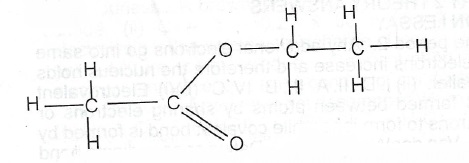
I. State the functional group in X; II. Give the IUPAC name of X; Ill. State the homologous series to which X belongs. IV. Give the names of two compounds from which X is formed. V. State one physical characteristt of X.
(b)(i) List two products obtained from fractional distillation of petroleum;
(ii) State one use of each product in (b)(i) above,
(iii) Mention one disadvantage of crude oil production
(c)(i) Mention the monomer of protein (ii) A compound has an empirical formula of CHO\(_2\) and its molar mass is 90. Deduce the molecular formula of the compound. [H = 1, C = 12, O = 16].
(d) Use the reaction scheme below to answer questions (i).— (iv).
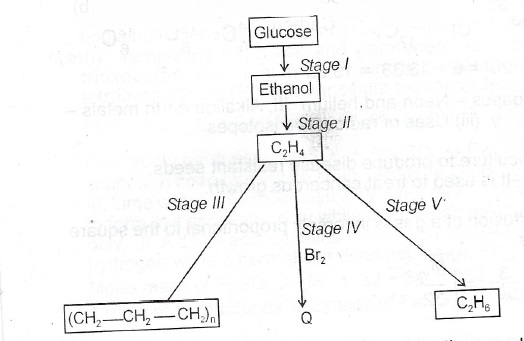
(i) State the reagents needed for stages II and V;
(ii) Nanie the product Q of reaction in stage IV;
(iii) State the conditions required for stage III;
(iv) Give the names of the processes in stages I, II, Ill and V respectively.
