


(i) Draw and label an energy profile diagram of an endothermic reaction. Indicate on your diagram the I. activation energy II. heat change, \(\Delta\)H.
(ii) Explain how the rate of reaction is affected by I. addition of a catalyst, II. increase in temperature.
(b)(i) Write an equation for the thermal decomposition of calcium trioxocarbonate (IV)
(ii) Determine the volume of carbon (IV) oxide measured at s.t.p. that would he produced by the thermal decomposition of 10g calcium trioxocarbonate (IV). [ Ca = 40; O = 16; C = 12 ]
(c)(i) Give one use cf each of the following forms of carbon: I. coal; II. wood charcoal; Ill. carbon (IV) oxide.
(ii) Write a balanced chemical equation to show what happens when each of the following compounds is heated strongly: I. NaNO\(_{3(s)}\) II. MgCO\(_{3(s)}\).
(d) Consider the following compounds: CaO, CaCO\(_3\), Ca(OH)\(_2\), NaOH Which of them is
(i) used in the manufacture of cement;
(ii) used to detect the presence of carbon (IV) oxide;
(iii) used to liberate carbon (IV) oxide when dilute acid is added;
(iv) hygroscopic;
(v) deliquescent?
a) Define each of the following terms and indicate one use of each:
(i) Nuclear fission; (ii) Nuclear fusion.
(b) Alpha particle emission by \(^{293}_{25}U\) proceduces an element A. Beta particle emission by the particle A produces another element B. Element B also undergoes alpha particle emission to produce \(^{227}_{89}AC\). Write balanced equations to represent the above statement.
(c) The models below represent the filling of orbitals in an atom.
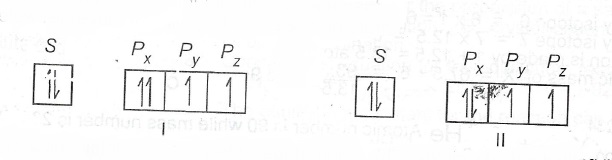
State which rule(s) is/are violated or obeyed by each model.
(d) Explain why the boiling point of H\(_2\)S with relative molecular mass of 34 is lower than that of H\(_2\)O with relative molecular mass of 18.
(e) HCI is passed into each of the following solvents:
(i) water;
(ii) methylbenzene. I. State the effect of each solution on blue litmus paper II. Compare the electrical conductivities of the two solutions.
(f) Zinc dust is added to copper (II) tetraoxosulphate (VI) solution. State;
(i) what is observed; (ii) the type of reaction that occurs.
(a)(i) State two differences betwecii the properties of solids and gases
(ii) What process does each of X, Y and Z represent in the changes shown below?
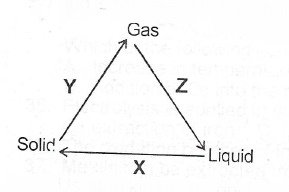
(b)(i) State Charles' Law (ii) Draw a sketch to graphically illustrate Charles' Law.
(c) 60 cm of hydrogen diffused through a porous membrane in 10 minutes. The same volume of a gas G diffused through the same membrane in 37.4 minutes. Determine the relative molecular mass of G. [ H = I ]
(d)(i) State two assumptions X of the kinetic theory.
(ii) Consider the reaction represented by the Solid of Liquid following equation:
H\(_{2(g)}\) + Cl\(_{2(g)}\) \(\to\) 2HCI\(_{(g)}\)
Use the kinetic theory to explain how the rate of formation of HCI\(_{(g)}\) would be affected by I. increase in temperature; II. decrease in pressure.
(e) Given different examples, mention one metal in each case vihich produces hydrogen on reacting with (i) dilute mineral acid; (ii) cold water; (iii) steam; (iv) hot, concentrated alkali.
(a) State the following laws of chemical combination: (i) Law of constant composition (ii) Law of multiple' proportion.
(b) Copper reacts with oxygen to form two oxides X and Y. On analysis, 1.535 g of X yielded 1.365 g copper and 1.450 g of Y yielded 1.160 g of cooper.
i) Determine the chemical formula of X and Y.
(ii) Calculate the mass of copper which can react with 0.500 g of oxygen to yield I. X II. Y.
(iii) Which of the laws of chemical combination is illustrated by the result in (b)(i) above. [ = 16, Cu = 63.51]
(c) Write the structure of the product responsible for the observation in each of the following reactions:
(i) A mixture of butanoic acid and ethanol warmed in the presence of concentrated H\(_2\)SO\(_4\) gives off a fragrant odour.
(ii) Sodium dissolves in propan-2-ol with effervescence to give a solution which on evaporation to dryness leaves a white precipitate.
(d) Consider the compound CH\(_3\)CH\(_2\)COOCH\(_2\)CH\(_3\).
(i) Name the compound (ii) Write the structural formula of the compound (iii) State the reagents and conditions for the formation of the compound.
(a) A solution of CuSO\(_4\) was electrolyzed between pure copper electrodes and the following results were obtained:
Mass of copper anode before experiment = 7.20 g
Mass of copper anode after experiment = 4.00 g
Mass of copper cathode before experiment = 5.75 g
From the information provided,
(i) calculate the mass of the cathode, after the experiment.
(ii) write an equation for the reaction at the I. anode, II. cathode.
(iii) state whether the colour of the solution would change during the electrolysis. Give a reason for your answer.
(iv) if the electrolysis was carried out for 1 hour 20 minutes with a current of 2.0 amperes, determine the value of the Faraday.
(b) Consider the reaction represented by the following equation:
MnO\(^-_4\) + I\(^-\) + H\(^+\) \(\to\) I\(_2\) + H\(_2\)O + Mn\(^{2+}\)
Write balanced half equation for the (i) oxidation reaction, (ii) reduction reaction.
(c)(i) Describe briefly how tin can be extracted from its ore.
(ii) State one use of tin.
(iii) Mention one property that makes tin suitable for the use stated in (c)(ii)
(d)(i) What is meant by the term pollution?
(ii) Explain why it is dangerous to run a generator in a closed room.


