


SECTION B
Answer all the questions in this section
Study specimens L, M, P, and Q and answer questions 3(a) to 3(d).
(a) Name the region of the human body where each of specimens L and Q are located.
L:
Q:
b(i) State four observable differences between specimens L and Q.
| L | Q |
(ii) State four observable similarities between specimens L and Q.
c(i) Name two bones each that articulate with specimens M and P.
(ii) Name one vertebra each that is located and after each of specimens L and Q in the vertebral column.
Before After
L: ................................. ....................................
Q: ................................ .....................................
(d) Complete the table below by using tick (✔) to indicate presence and cross (X) to indicate absence of the following features in each of specimens L, M, P and Q.
| Specimen | Features | |||
| Neural canal | Rounded head | Neural spine | Long shaft | |
| L | ||||
| M | X | |||
| P | ||||
| Q | ✔ | |||
The Genus into which man is classified is
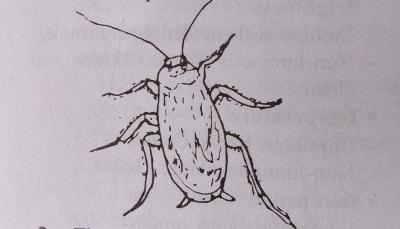
The diagram above is an illustration of the nymph of an insect. Study it and answer the question below:
The organism illustrated is a stage in the

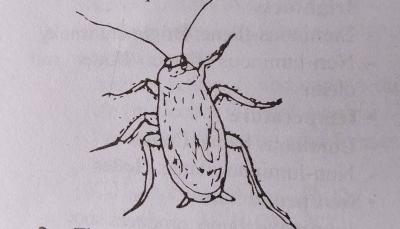
The diagram above is an illustration of the nymph of an insect. Study it and answer the question below:
The growth process that would occur in the organism before it becomes an adult is
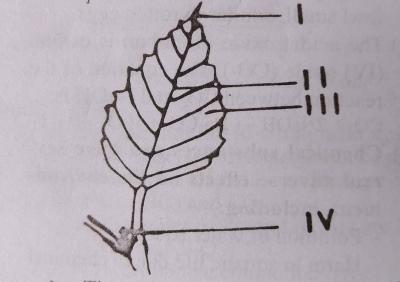
The diagram above is an illustration of a dicot leaf. Study it and answer the question below.
The parts labelled I,II,III and IV respectively are
