


(a) What are conversation laws?
(i) State three conservation laws
(b) State two reasons why animals are poached.
(i) Name five animals that are commonly poached.
(c) State four effects of excessive use of the forest.
(d) Explain briefly the following terms: i.blood transfusion ii.antigen
5.(a) State three differences between the alimentary canals of earthworm and cockroach.
(i) State three similarities between the alimentary canals of earthworm and cockroach.
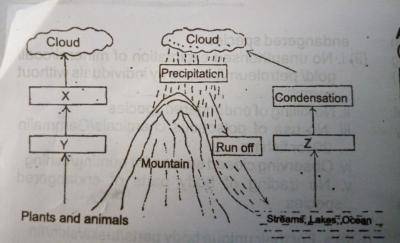
(b) The diagram below is an illustration of a biological cycle.
Study it and answer questions 5(b)i) to 5(b)(iii)
[i]Name the biological cycle (i) Explain briefly three roles played by plants and animals in the cycle (ii) Name the process that occur in X, Y and Z.
c. complete the table below.
| organs associated with excretion in human | three diseases that affect the organ |
(d)i) What is decay of organic matter
(i) Name two groups of organisms that cause decay of organic matter.
(i) State one other factor that causes decay.
(iv) Name the biological cycle that involves decay.
(e) Explain briefly the mode of nutrition in carnivorous plants.
5.(a) State three differences between the alimentary canals of earthworm and cockroach.
(i) State three similarities between the alimentary canals of earthworm and cockroach.
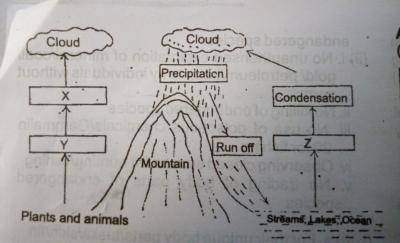
(b) The diagram below is an illustration of a biological cycle.
Study it and answer questions 5(b)i) to 5(b)(iii)
[i]Name the biological cycle (i) Explain briefly three roles played by plants and animals in the cycle (ii) Name the process that occur in X, Y and Z.
c. complete the table below.
| organs associated with excretion in human | three diseases that affect the organ |
(d)i) What is decay of organic matter
(i) Name two groups of organisms that cause decay of organic matter.
(i) State one other factor that causes decay.
(iv) Name the biological cycle that involves decay.
(e) Explain briefly the mode of nutrition in carnivorous plants.
specimens A and C and answer question 1(a) to 1(e).
(a) Classify specimens A and C based on their life cycle.
A;.....................................................................
B;.......................................................................
(b) State four observable differences between specimens A and C.
(c) State three ways by which the damage to specimen A could have been prevented.
(d) Name the type of germination that would be observed when specimens A and C are planted.
A...........................................................
C...........................................................
(e) Place a flat side of specimen C on the tile.
provided, cut through the specimen longitudinally.
Make a drawing, 6 cm to 8 cm long of the cut surface of one half of specimen c and label fully.
specimen C and label fully.
(i) Add a drop of iodine solution to the cut surface of th other half of specimen C and record the activity on the table below
Study specimen D and E and answer questions
(a) and (b).
(a)i Name the specific habitats of each of specimens D and E.
D:...........................................
E:...........................................
(i) State five observable structural difference between specimens D and E.
(i) What is the behavioural adaptation that specimens D and E exhibit? (b) State two ways by which specimen E is of economic importance.
Study specimen G and answer questions 2(c) to (e).
(c) On the table below, name the types of teeth present in specimen G and state one function each of the types of teeth named.
| types of teeth | one function |
(d)(i) Name the mode of feeding of the organism from which specimen G was obtained.
(ii)(d) Name the mode of feeding of the organism from which specimen G was obtained.
State three ways by which specimen G adapts its organism to the mode of feeding stated in (d)(i)
(e) Name two mineral elements which are needed for the proper functioning of specimen G in the body.

