


a. (i) Complete the table below with the respiratory surface of each of the listed organisms.
| organism | respiratory surface |
| Tadpole (2days old) | |
| Cockroach | |
| Domestic fowl | |
| Talinum | |
| Earth Worm | |
| Amoeba |
(ii) State five characteristic features of respiratory surfaces in organisms. [5 marks]
b. Make a drawing, 4 cm – 6 cm long of the respiratory organ in Tilapia and label fully. [9 marks]
b. List five parts of the alimentary canal of an earthworm. [5 marks]
c. State six ways by which water could be polluted by agricultural. [6 marks]
d. Describe briefly the life cycle of a housefly. [5 marks]
e. Make a diagram, 6 cm – 8 cm long of the hypogeal germination in a mature maize seedling and label fully. [8 marks]
Diagrams A, B and C are illustrations of different types of teeth in humans. Diagram D is a representation of the arrangement of teeth in the lower jaw of a human.
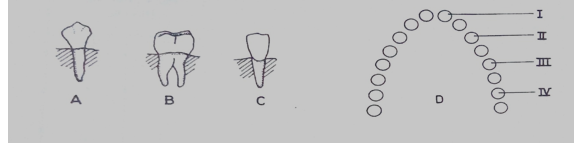
Study them and answer questions (a) to (f).
(a) (i) Name the type of teeth in diagrams A, B, and C.
(ii) Which of the teeth would be found in positions I, II and IV?
(iii)State one function each of the teeth illustrated in diagrams A, B and C.
(iv) State one reason each for the answers in (a) (iii).
(b)If the tooth labeled B is decayed, list two factors that may be responsible.
(c)What is the total number of each of the teeth labeled A, B and C in the dentition of an adult human?
(d)Which of the teeth would be absent in a rabbit?
(e)(i) Name the tooth that would be found in position III of diagram D.
(ii) In which of the parts labeled I, II, III and IV would a tooth not be found in an infant?
(f) State five ways of caring for the teeth in humans.

Diagrams D, E and F are illustrations of tools used for ecological studies. Study them and answer questions (a) to (c).
(a)(i) Identify diagrams D, E and F.
(b) State one use each of the tools labeled D, E and F.
(c) Describe briefly the use of each of the tools labeled D, E and F.
The diagrams below are illustrations of two organisms. Study them and answer question 3 (a) to (f)
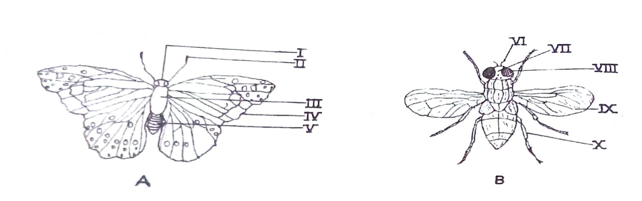
(a)(i) Identify organisms A and B.
(ii) Name the parts labeled I to X.
(b) State one function each of the parts labeled VI, VIII, IX and X.
(c) Name the specific habitats of organisms A and B.
(d) State three structural adaptations of organism A to its mode of life.
(e)(i)State three structural similarities between organisms A and B.
(ii) State three structural differences between organisms A and B.
(f)(i) Name the class of organisms A and B.
(ii) State three reasons for the answer in (f) (i).
(g)State one biological importance of organism A.
