


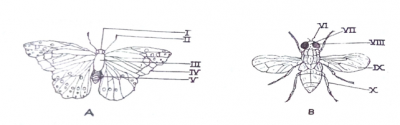
(a)(i) Identify organisms A and B. [2 marks]
(ii) Name the parts labeled I to X. [5 marks]
(b) State one function each of the parts labeled VI, VIII, IX and X. [4 marks]
(c) Name the specific habitats of organisms A and B. [2 marks]
(d) State three structural adaptations of organism A to its mode of life. [6 marks]
(e)(i)State three structural similarities between organisms A and B [3 marks]
(ii) State three structural differences between organisms A and B. [3 marks]
(f)(i) Name the class of organisms A and B. [1 marks]
(ii) State three reasons for the answer in 3 (f) (i). [3 marks]
(g)State one biological importance of organism A. [1 marks]
a. Name five vertebrae in mammals with their corresponding locations. [10 marks]
b. State one function each of the following parts in a dicotyledonous leaf:
(i) palisade;
(ii) vascular bundle;
(iii) epidermis. [3 marks]
c. State one function each of the following parts in the stem of a flowering plant:
(i) sieve tube;
(ii) cortex;
(iii) pith.
d. In a tabular form, state:
(i) two external structural differences between the stem and root of a maize seeding. [2 marks]
(ii) two internal structural differences between the stem and root of a maize seeding. [2 marks]
a. State three features of the small intestine that increase the rate of absorption of digested food. [3 marks]
b. Explain briefly what happens to the glucose formed in a plant during photosynthesis. [3 marks]
c. Explain briefly the mode of feeding in each of the following organisms:
(i) Euglena; [4 marks]
(ii) Spirogyra. [4 marks]
d. State three characteristics of an Estuarine habitat. [3 marks]
e. State three differences between an aquatic habitat and a terrestrial habitat. [3 marks]

a. State five :
(i) challenges that make conservation of resources difficult; [5 marks]
(ii) ways by which the Government of a country ensures conservation of natural resources. [5 marks]
b. What is an endangered species? [3 marks]
c. A child with blood group O was born to a mother of blood group A.
(i) What is the blood group genotype of the child? [1 marks]
(ii) What are the possible blood group genotypes of the father? [3 marks]
d. State three reasons why genetic variation is important to plants. [3 marks]
A homozygous tall, red flower plant was crossed with a homozygous dwarf, white flower plant. The F1 were selfed and 160 F2 plants were obtained.
a.(i) Name the type of genetic cross. [1 marks]
(ii) State one reason for the answer in 4(a)(i). [1 marks]
b.(i) What is evolution? [2 marks]
(ii) With the aid of a genetic diagram, state the phenotypic ratio of F2 generation. [13 marks]
(iii) Calculate the number of tall and white flowers that would be obtained in the F2 generation. [3 marks]
