Post-UTME Past Questions - Original materials are available here - Download PDF for your school of choice + 1 year SMS alerts
Your School's Whatsapp Group - Join Us now

Biology WAEC Past Questions

Clear Selections
Change Subject Post a Question Check Syllabus Study My Bookmarks Past Questions Videos Watch Video Lessons Download App

WAEC and NECO CBT Software for Computers and Laptops - Candidates, Schools, Centres, Resellers - 100% Offline -Download Now
Your School's Whatsapp Group - Join Us now
WAEC and NECO CBT App for Mobile Devices - Candidates, Schools, Centres, Resellers - 100% Offline -Download Now
1911

(a)Describe briefly the process involved in the conversion of food to chyme in the stomach of a mammal.                                                                                                          
(b)Complete the table below by stating one enzyme, digestive juice, food acted upon and
end-product in the corresponding spaces.


One Enzyme

One juice

One food acted upon

One end-product


Pepsin

(i) -----------

Lipase


(ii)---------------

(iii)---------------

(iv)---------------


(v) --------------------

(vi) -------------------

(vii) -------------------


(viii)-------------------

Maltose

(ix)-----------------------


(c) Describe an experiment to show that carbon dioxide is necessary for photosynthesis.


View Answer & Discuss WAEC 2018
1912

(a)  Explain briefly the following terms:

  1. ecosystem;
  2. abiotic environment.                                                         

(b)  List three ecological factors each which are specific to:

  1. aquatic habitats;
  2. terrestrial habitats.                                                           

(c)  State briefly the relationship between green grass and a rabbit in a given habitat.
(d)  Draw a typical pyramid of energy using four feeding levels.  


View Answer & Discuss WAEC 2018
1913


(a)(i)  State Mendel’s laws of inheritance.                                       

(ii) State five applications of genetics in medicine.                         

(iii) State three disadvantages of inbreeding.                                 

(b)(i) What is evolution?                                       
(ii) Distinguish between convergent evolution and divergent evolution.     

View Answer & Discuss WAEC 2018
Your School's Whatsapp Group - Join Us now
WAEC and NECO CBT App for Mobile Devices - Candidates, Schools, Centres, Resellers - 100% Offline -Download Now
WAEC and NECO CBT Software for Computers and Laptops - Candidates, Schools, Centres, Resellers - 100% Offline -Download Now
1914

(a)   State five processes involved in the water cycle.                         
(b)   Name one instrument used for measuring each of the following physical factors:

  1. pH;
  2. light intensity;
  3. turbidity;
  4. temperature.                                                        

(c)  Explain briefly the contributions of the following scientists to the formulation of the cell theory:

  1. Robert Hooke;                                                       
  2. Theodore Schwann.                                                   

(d) What is meant by each of the following terms:

  1. Nastism                                                     
  2. Taxism                                                       

(e) Make a diagram, 6 cm – 8 cm long of the human tongue illustrating the four areas of taste.
(f)(i)   List four ways through which microorganisms enter the human body.                    
(ii)   State three harmful effects of microorganisms to humans.                             

View Answer & Discuss WAEC 2018
1915

Diagrams A, B and C are illustrations of different types of teeth in humans. Diagram D is a representation of the arrangement of teeth in the lower jaw of a human.
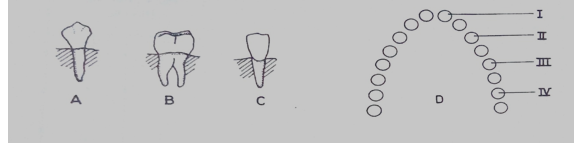
Study them and answer questions  (a) to (f).
(a) (i) Name the type of teeth in diagrams A, B, and C.                                   

(ii) Which of the teeth would be found in positions I, II and IV?             

(iii)State one function each of the teeth illustrated in diagrams A, B and C.         

(iv) State one reason each for the answers in (a) (iii).                             

(b)If the tooth labeled B is decayed, list two factors that may be responsible.                 
(c)What is the total number of each of the teeth labeled A, B and C in the dentition of an adult human?                                            
(d)Which of the teeth would be absent in a rabbit?                                                          
(e)(i)  Name the tooth that would be found in position III of diagram D.      
(ii)  In which of the parts labeled I, II, III and IV would a tooth not be found in an infant?                       
(f)  State five ways of caring for the teeth in humans.

View Answer & Discuss WAEC 2018
Start a Free Practice Test
 
WAEC and NECO CBT App for Mobile Devices - Candidates, Schools, Centres, Resellers - 100% Offline -Download Now
Your School's Whatsapp Group - Join Us now
Post UTME Past Questions Agent
WAEC and NECO CBT Software for Computers and Laptops - Candidates, Schools, Centres, Resellers - 100% Offline -Download Now
