


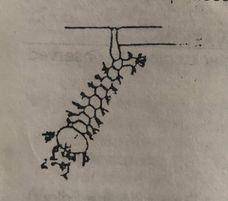
(a) Name the organism represented in the diagram above (b) Name the structure labelled x (c) Into what stage would the organism develop?
You are provided with specimens A, B and C (a) identify specimens A, B and C without reason.
(b) Make a labelled drawing 6-8 cm long of the longitudinal section of specimen A to illustrate its essential features
(c) (i) Suggest the possible means of pollination of specimen A (ii) Give three reasons for your answer
(d) (i) Name one agent of dispersal each for specimen B and C (ii) Give one reason each for your answer.
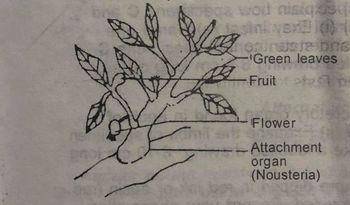
(a) identify specimen D without giving reason (b) (i) State two observable features of specimen D which indicate its mode of nutrition (b) (ii) What is the mode of nutrition cf specimen D? (c) Make a labelled drawing to show features of biological importance of the specimen (d) (i) Examine and identify without reasons specimens E and F

Specimen G is a paste made from a food material. Carry out the following tests to identify the food substances contained in specimen G. Wash the test tube after each use to ensure that the next sample is not contaminated. All tests and observations should be recorded in a table as shown below.
| Test | observation | inference |
(a) (i) Pour 5 cm/(^3/) of specimen G into a test tube and add three drops of sodium hydroxide solution. Shake two test tube. Record your observation. Then add three drops of copper (ii) tetraoxosulphate (VI) solution (CuSO/(_4/)). Shake the test tube. Record your observations and inference (b) Pour 5 cm/(^3/) of specimen G into a test tube and three drops of Sudan IIl. Shake the mixture. Record your observation and inference (d) To another 5 cm/(^3/) of specimen G add four drops of Fehling's solution. Shake the test tube. Warm the mixture. Record your observation and inference

