


(a) (i) Define the term population. (ii) List two biotic and abiotic factors each that affect population growth.
(b) What are the effects of food shortage on a population?
(c) Describe two methods each for:
(i) improving crop yield (ii) preserving and storing food. Explain the principle involved in each of the methods described.
(a) What is conservation of natural resources?
(b) List various natural resources that need to be conserved. State briefly the benefits of conservation in each case.
(c) List the problems often encountered in ensuring conservation of natural resources.
(d) What are the efforts being employed in your country to ensure conservation of natural resources?
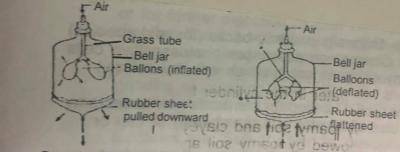
The set-up in diagrams I and II illustrate breathing mechanisms in mammals
(a) Name the structures in mammals that are equivalent in function to the parts labelled (i) glass tube (ii) bell jar (iii) balloons (iv) rubber sheets (v)A (vi) B.
(b) Name the processes illustrated by diagrams (i) I (i)
(c) In which of the bell jars is the pressure lower?


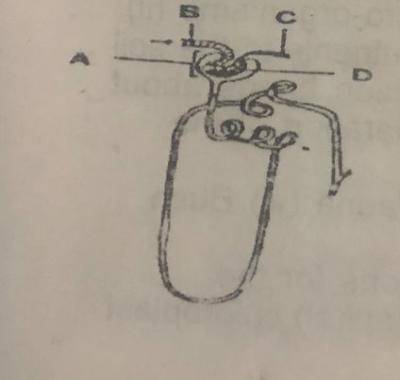
(a) Name the parts labelled A, B, C and D
(b) What is the significance of the relative size of B and C?
(c) Name the structures in: (i) Amoeba (ii) earthworm. Which are equivalent in function to the structure illustrated in the diagram

The diagram below represents the transverse section of a fruit (a) State the kind of placentation found in the fruit (b) Name one fruit that has this kind of placentation
