


The diagram below illustrates the reproductive parts of livestock. Study it carefully and answer the questions that follow.
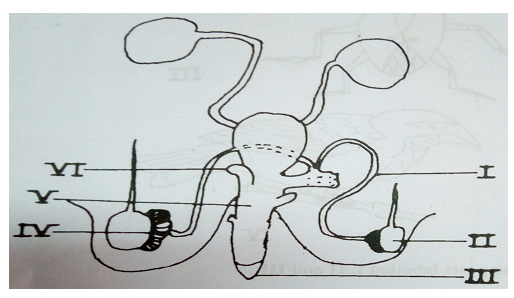
(a) Name the parts labelled I, II, III, IV, V and VI.
(b) State one function of each of the parts labelled I, II, III, IV, V and VI.
(c) To prevent indiscriminate mating in the herd, a farmer decided to carry out a management practice to alter the functioning of the parts illustrated above.
(i) Name the management practice.
(ii) Name the two main parts of the illustrated diagram that would be of utmost benefit to the farmer in carrying out the management practice named in (c)(i).
(a) State seven ways in which agriculture is important to the economy of West Africa.
(b) Give two advantages of each of the following sources of farm power:
(i) internal combustion engine;
(ii) electricity;
(iii) wind.
(c) State five operations in poultry production which could be carried out through the use of
electrical power.
(a) State six problems of agricultural development in West Africa.
(b) Explain each of the following farm practices:
(i) crop rotation;
(ii) mixed farming.
(c) State three advantages of each of the following farm practices:
(i) crop rotation;
(ii) mixed farming.

(a) Give two examples of each of the following classes of crops:
(i) roots and tubers;
(ii) oil crops;
(iii) grain legumes;
(iv)cereals.
(b) State five differences between the digestive system of a goat and a chicken.
(c) Give five reasons why farmers keep records.
(a) Explain briefly two types of soil water.
(b) State four management practices carried out during the brooding of chicks.
(c) Complete the table below on diseases of farm animals.
Disease |
Causal organism |
Vaccine/drug administered |
|
Marek’s disease |
(i) |
(ii) |
|
(iii) |
(iv) |
NDV La Sota |
|
Coccidiosis |
(v) |
(vi) |
|
Anthrax |
(vii) |
(viii) |

