


a) Explain each of the following terms as used in animal production:
(i) flushing;
(ii) castration;
(iii) culling.
(b) Mention two advantages of each of the terms in 5 (a).
(i) Flushing;
(ii) Castration;
(iii) Culling.
(c) Give two uses of each of the following survey equipment:
(i) prismatic compass;
(ii) measuring tape.
(d) Differentiate between the terms floriculture and aquaculture.
(a) A farmer purchased a tractor in the year 2000 for D 12, 000.00. In 2009, the tractor was
sold for D 3,000.00 as it was no longer economical to keep. Calculate the:
(i) useful life of the tractor;
(ii) salvage value of the tractor;
(iii) total depreciation of the tractor;
(iv) annual depreciation of the tractor.
(b) Describe the following terms as used in agricultural economics:
(i) demand schedule;
(ii) supply curve.
(c) List four agricultural extension agencies in West Africa.
(d) State four ways through which soils are enriched with nitrogen.
The diagram below illustrates an experimental set-up in soil analysis. Study it carefully and answer the questions that follow.
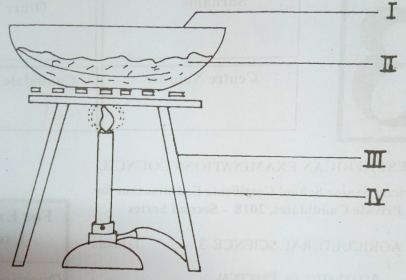
(a) State the aim of the illustrated experiment.
(b) Name the part labelled I, II, III and IV.
(c) A fresh sample of soil weighed 60 g. A container weighing 35 g was used to dry the soil. If both the soil and the container weighed 80 g after the experiment, determine the:
(i) weight of the dried soil;
(ii) weight of the water lost from the soil;
(iii) percentage of water lost from the soil.
(d) List three forms in which water exists in the soil.
The plan below represents the survey of a farm. Use it to answer questions (a) and (b).
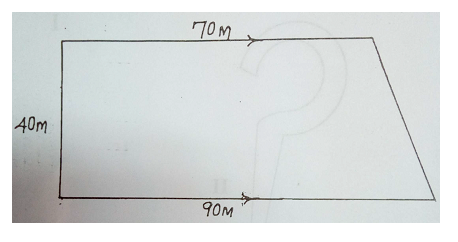
(a) Calculate the area of the farmland.
(b) If the farmland is planted with banana at a spacing of 4 m x 4 m, what will be the population of banana plants on the farm?
(c) Study the diagrams labelled I and II below and answer the questions that follow.
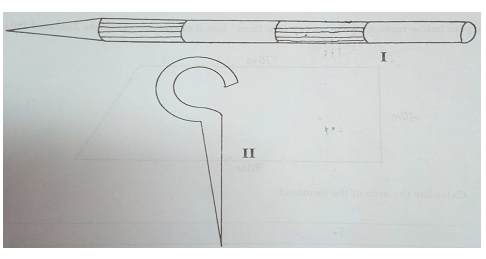
(i) Name the tools labelled I and II.
(ii) State two uses of each of the tools labelled I and II.
(iii) State one general way of maintaining the tools labelled I and II.
The diagrams below illustrate pests of crops. Study them and answer the questions that follow.
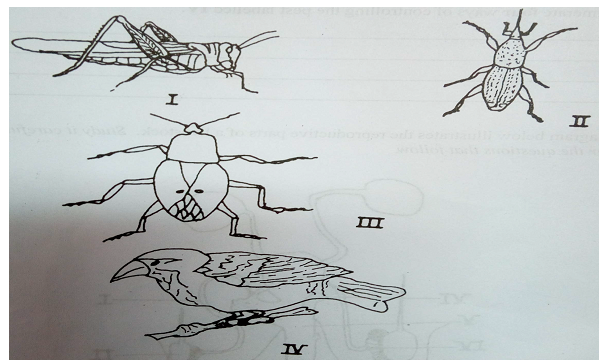
(a) Name each of the pests labelled I, II and III.
(b) Describe the life cycle of the pest labelled I.
(c) State four damages caused by the pest labelled III on crops.
(d) Enumerate four ways of controlling the pest labelled IV.


