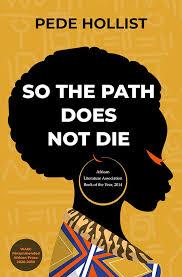
So the Path Does Not Die
The content of the novels on this website is provided as summaries to assist with revision. Candidates should ensure they read and fully understand all the relevant novels before the exams.
So the Path Does Not Die
Prologue-Chapter 4
Prologue
The novel opens with the mythic tale of Musudugu, a feminist utopia defined by harmony and female agency. In this legendary village, women live entirely free from male dominance, governed by the supreme deity Atala and his daughter. Symbolically, Musudugu represents an "unblemished African culture" existing in a state of pure unity before the metaphorical "knife" of external influence or patriarchal corruption severs its social fabric. The setting introduces a radical reversal of gender roles, as men are only permitted for procreation and must depart by sundown, while male children are exiled as soon as they reach a certain physical maturity.
The legend focuses on Kumba Kargbo, whose breech birth serves as a vital foreshadowing of her unconventional life and her role as a "mirror" for the protagonist, Finaba. Kumba is a natural dissenter who questions why men are excluded. This highlights a theme where traditions are practised even after their logical origins are forgotten. Seeking knowledge, Kumba leaves the village and grows into a literal giant. Her "inhuman increase in size" serves as a metaphor for the burden of Western knowledge; when she returns, she is too "large" for the traditional structure she once called home. Tragically, her attempts to reintegrate lead to the inadvertent destruction of the village, illustrating the devastating impact of "foreign" civilisation when it is not carefully integrated with ancestral roots.
Chapter 1
The narrative transitions to the rural village of Talaba, a traditional Muslim Fula society that serves as the literal "starting point" of the path. Here, life is communal and governed by strict ethnic and religious codes. We are introduced to Fina’s parents, Amadu and Nabou, whose scepticism toward tribal initiation rites stems from the traumatic death of their first daughter, Dimusu, following her circumcision. This creates a central "man vs. society" conflict, as their private grief clashes with the village’s collective expectation that every girl must undergo the rite to achieve womanhood.
Standing in direct opposition to the parents is the grandmother, Baramusu, the "Guardian of the Path." She dismisses the previous tragedy as an act of destiny rather than a flaw in the ritual, viewing Western education as a direct threat to cultural preservation. The chapter concludes with a powerful instance of irony: despite her parents’ warnings, the young Fina—driven by a desperate need for communal belonging and the status of being a "real woman"—colludes with her grandmother to undergo the ritual in secret, demonstrating the overwhelming power of social peer pressure over individual safety.
Chapter 2
Fina enters the Fafei (the sacred circumcision shrine), a space that symbolises the "inner sanctum" of traditional culture where the "path" is physically carved into the female body. However, the initiation is violently interrupted when Amadu commits an unprecedented act of defiance. By invading the forbidden female shrine to snatch Fina away, Amadu establishes himself as a "recalcitrant" figure who chooses his daughter’s life over cultural sanctity. This invasion creates a "sacrilegious crack" in the family's relationship with the village, leading to a fierce backlash from the local women.
The resulting conflict highlights a grim theme: when tradition becomes stifling and restrictive, it can lead to the dehumanisation of the individual. The villagers’ outrage proves they prioritise the purity of the custom over Fina’s survival. Realising that Talaba has become a hostile environment, the family flees to a clinic and eventually toward Freetown. This move represents a major plot development of exile, signalling a psychological shift from a communal, rural identity to an individualistic, urban one in search of a "saner clime."
Chapter 3
Arriving in Freetown, the family seeks "psychic sanctuary" but instead encounters a rigid social hierarchy. Their first meeting with the elite Pa Heddle, where they are forced to leap aside for his car, establishes their status as the "dishevelled trio" at the bottom of the urban ladder. Amadu takes a job as a labourer but soon becomes entangled in the city's systemic corruption. Observing that the elite siphon government resources, he begins stealing building materials to survive. This "eat or be eaten" mentality serves as a critique of Freetown’s illicit foundations.
Tragedy strikes when Amadu dies of tetanus after a workplace injury, a death rich in irony as he is killed by a "rusty corrugated iron sheet"—a symbol of the industrial dangers of the city that proved just as lethal as the traditions of the village. Following his death, Fina is taken in by the Heddles as a foster child, entering the house through the "back door" to symbolise her permanent status as an "outsider." The Heddle home becomes a site of psychological trauma, where Fina suffers physical abuse and the symbolic destruction of her only photograph of her mother. Despite the hypocrisy and cruelty of the elite, Fina adopts a mantra of "pain for gain," choosing to endure Pa Heddle’s abuse as her only viable path toward an education.
Chapter 4
Fina eventually enrols at Crowther College, nicknamed "Mount Olympus" due to its physical altitude and the perceived superiority of its students. This setting symbolises an intellectual disconnect from the common struggles of the city. However, the "citadel of learning" is not a sanctuary; Fina witnesses domestic violence and encounters a cycle of silence and complicity. The theme of tribalism becomes a "sharp arrow" when a campus crowd targets Fina with derogatory songs mocking her Fula heritage, revealing that ethnic hatred is just as prevalent among the educated elite as it is in the villages.
Fina’s academic journey becomes a post-colonial critique, as her supportive American professor is replaced by rigid, UK-educated faculty who represent a different struggle over the "African imagination." Fearing academic failure, Fina turns to the predatory lab technician Kizzy Bacchus. Kizzy’s "misanthropic disposition" masks a sinister intent, culminating in a brutal sexual assault that serves as the climax of Fina's trauma. Following a vision of her ancestors arguing over her "path," Fina flees the campus and retreats to her mother. Despite this bitter experience, the chapter ends on a note of resilience as Fina finds work at a Christian mission in Koidu, viewing this new distance as a "door of opportunity" toward her ultimate goal of reaching America.