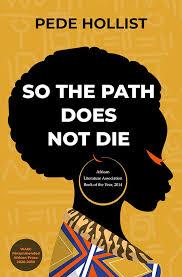
So the Path Does Not Die
The content of the novels on this website is provided as summaries to assist with revision. Candidates should ensure they read and fully understand all the relevant novels before the exams.
So the Path Does Not Die
Chapters 5-9
Chapter 5
In this chapter, Fina develops a profound bond with Meredith, an American missionary whose sense of displacement in her own country mirrors Fina’s trauma. Meredith serves as a character contrast to the "arrogant" Westerners Fina has previously encountered. Meredith’s vocal disdain for the systemic corruption in Sierra Leone inspires Fina to maintain her own moral resolve. This resolve is immediately tested by Sidibe Kakay, a wealthy diamond merchant who attempts to woo Fina using the "glitter bath" (a seduction technique where he showers her in diamonds). Here, the symbolism of diamonds as "magical stones" reveals the commodification of relationships in a society where people are often traded for gain.
The chapter reaches a climax when Kakay reveals that Fina’s "principled" friends, Meredith and Chip, traded diamonds for Fina's US visa. This revelation shatters Fina’s idealistic view of her mentors and proves Kakay’s cynical mantra that "everything in life is a trade." Additionally, Fina’s interaction with Kakay’s third wife, Aziza, provides a feminist perspective on independence. Seeing Aziza’s hollow existence, despite her material comforts, reinforces Fina’s determination to seek true self-determination in America rather than becoming a trophy in a polygamous household.
Chapter 6
Fina’s arrival at JFK International Airport marks a sharp contrast of expectations. Having feared "redneck officers," she is instead met with a courteous process that fills her with "bouncy exhilaration". However, the reality of the Immigrant Burden soon sets in as Fina’s life becomes a "chess match" of survival. She has to balance multiple jobs, community college and the crushing obligation to send money back to her mother.
The narrative explores Intra-Racial Tension when Fina is fired from her childcare job by Juanita, a Black business owner who stereotypes Africans as "animalistic" in their treatment of children. This betrayal by a member of her own race devastates Fina and forces her to move to Langley Park, Maryland. In this "epicentre of immigrant activity," she finds a cultural comfort zone and reconnects with her foster sister, Edna. The chapter ends with a chilling realisation that the "ghosts of the past" are inescapable; Edna reveals she is engaged to Kizzy, the man who raped Fina in Freetown. This highlights the recurring theme that the migrant can cross oceans, but they cannot outrun their trauma.
Chapter 7
This chapter focuses on the Theme of Identity Construction through the character of Amanzinga, whose reclamation of her African heritage contrasts with Fina, who simply "lived" the culture without needing to perform it. Their friendship highlights Intra-Racial Prejudice, as Fina initially assumes that the stereotypical remarks she hears about "Kunte Kinte’s sisters" are coming from Amanzinga herself. Amidst this tension, Fina faces the ultimate Immigrant’s Dilemma when her mother dies suddenly; she is forced to mourn from afar, wiring money for a burial she cannot attend without losing her legal status.
To secure her future, Fina enters a transactional marriage with Jemal, a "veteran abuser." This choice mirrors her father's earlier sacrilege in the village, as both involve a "Gain for Pain" trade. The climax occurs on the morning of her green card interview, where Fina threatens a drugged-out Jemal with a meat cleaver to ensure his cooperation. While she successfully attains legal status, the chapter concludes by highlighting the void of materialism. Despite owning a townhouse and a car, Fina remains unfulfilled.
Chapter 8
A party hosted by Cammy, a successful Trinidadian urologist, serves as a backdrop for a shift in Fina's life. The symbolism of music acts as a bridge to her past, but her interaction with a neighbour, Leroy McKinney, highlights Diaspora Friction. When Leroy suggests Fina does not "look African" because she isn't a "jungle wild" caricature, Fina sharply rebukes his stereotypical views. This encounter underscores the struggle of Continental Africans to be seen as contemporary individuals rather than historical stereotypes.
The characterisation of Cammy challenges traditional norms; he is a brilliant surgeon with a "bodybuilder frame" and dreadlocks. The two find a deep intellectual connection through their shared history. Their romance is framed within the context of the American Dream, suggesting that the U.S. provides a unique social space where a Sierra Leonean and a Trinidadian can find a shared identity. They end the night feeling like the "centre of the universe," with their future appearing as a clear blueprint of their tomorrows.
Chapter 9
As Fina and Cammy’s relationship stabilises, a central Conflict of Perspective arises over a news report on Female Genital Mutilation (FGM). Cammy’s view as a Western-trained doctor clashes with Fina’s defence of her cultural identity. Fina uses the power of language to challenge his "double standards," coining the term "MGM" (Male Genital Mutilation) to force Cammy to recognise his own cultural biases. The tension reaches a turning point when Fina reveals she is a survivor of the practice; her anger stems from her refusal to be viewed as a medical "object" or a "psychological basket case."
The symbolism of the light becomes critical when Cammy secretly installs a clap-activated lamp to "see the front" during intimacy. This violation of trust represents an attempt to medicalise Fina’s body. This causes a deep rift between the couple. However, the chapter reaches a Resolution and Purpose when Cammy proposes marriage and supports Fina’s dream to return home. Fina decides to hold onto her "path"—not by abandoning her heritage or blindly defending it, but by returning to Sierra Leone to reform the practice from within.