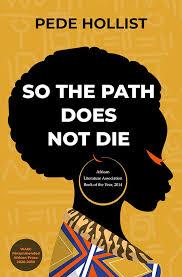
So the Path Does Not Die
The content of the novels on this website is provided as summaries to assist with revision. Candidates should ensure they read and fully understand all the relevant novels before the exams.
So the Path Does Not Die
Chapter 20-Epilogue
Chapter 20
Aman begins a symbolic "remaking of her life" by auctioning off her furniture, with the rising prices reflecting her growing self-worth and rejection of her "fickle" past. This process is interrupted by Bayo’s return; after a three-month coma in Nigeria, he proposes an immediate marriage and a return to Africa. This introduces a Conflict of traditional vs modern decision-making, as Bayo assumes his cultural "nest" is the default destination without seeking Aman's input. Meanwhile, Fina is hospitalised with a threatened miscarriage, a physical event that serves as a Symbolism of the Womb—representing the fragility of the "dual heritage" child, Dimusu-Celeste. Bayo’s use of the proverb about the bird leaving its nest justifies his return as a search for "nourishment and strength," though his description of the "insanity" of home (rats and viruses) serves as a sobering reality check.
Chapter 21
The Symbolism of the Buffet at Edna’s dinner—a medley of African and Caribbean foods—serves as a physical representation of the hybrid identity the characters have formed. However, a Philosophical Conflict erupts when Cammy dismisses Fina and Bayo's desire to return to Africa as "refuge in nostalgia." Cammy advocates for a Post-Nationalist view of being "bigger than one place," while Fina remains tethered to the Communalist need for a physical connection to the soil. This tension is heightened by Aman’s use of DNA analysis to find an "authentic" past, highlighting the irony that while the African American (Aman) seeks a specific place, the African (Cammy) seeks to transcend it. The chapter ends in betrayal; Cammy’s refusal to testify for Kizzy out of pride prompts Kizzy to weaponise Fina’s past trauma, delivering a "ghost" that threatens to destroy her relationship.
Chapter 22
Fina and Cammy attempt to "unload" their burdens in a moment of structural symmetry: Fina reveals her rape at Crowther College, while Cammy confesses to his involvement in a fatal hit-and-run in Trinidad. This Mirror of Trauma reveals that both have lived "guarded" lives, though Fina’s is one of victimisation while Cammy’s is one of guilt. The Moral Divide occurs when Fina urges Cammy to confess to save Kizzy from jail; Cammy refuses, choosing his individualistic status over communal accountability. During a kidney transplant for his son Glen, Fina feels like an "intruder" amidst the Caribbean bonding of the Priddy and Gibson families, confirming her Cultural Isolation. Though Cammy is eventually legally redeemed when he learns he was framed, he discovers that Fina has already left for Sierra Leone, her silent departure serving as her final act of "mending the rope" on her own terms.
Chapter 23: Reclamation in the Scorched Earth
Fina returns to Freetown, moving from victim to benefactor as she walks through the "front door" of the Heddle home to provide for those who once fostered her. However, her journey to Talaba reveals a "harvest of skeletons" and scorched earth. The Symbolism of the Disintegrating Rope—a physical fragment of ritual rope that turns to dust in her hands—proves that the old, rigid traditional path is dead. Fina finds a new Surrogate Belonging in Mawaf, a traumatised child soldier, and Mama Yegbe, an elderly blind woman. Mawaf’s horrific account of the war illustrates the "insanity" that has replaced tradition. The novel reaches a spiritual resolution as Mama Yegbe performs a naming ceremony for Dimusu-Celeste, using salt and oil to symbolise the child's integration of African and Western worlds. Fina finds her true path, transitioning into a leader who provides "solace and succour" for the wounded children of her land.
Chapter 24: Reciprocal Sacrifice
Fina travels to Lagos for Aman and Bayo’s wedding, where she sees Aman successfully adapting to the realities of Nigerian life. Cammy arrives, physically transformed after his kidney surgery and having cut his dreadlocks, signifying a newfound humility. A power outage at the wedding leads to a Political Resolution when Bayo refuses to pay a "dash" (bribe), choosing integrity over convenience. Walking along Victoria Island beach, Fina and Cammy view the Atlantic as a "menacing presence" of Black suffering. They agree to a Theme of Reciprocal Sacrifice, deciding on "alternate visits" rather than forcing one path to win over the other. The "Path" remains alive as Fina stays committed to her rehabilitation centre, and Cammy finds a reason to traverse the ocean for a love that is now a "rough diamond."
Epilogue: The New Musudugu
Three years later, Fina, Cammy, and Mawaf have formed a stable, surrogate family in Sierra Leone. The Theme of Synthesis is fully realized through Dimusu-Celeste, who offers a "Happy Ending" to the myth of Musudugu: in her version, men and women work together to build a new utopia. This revision is the ultimate message of the book—that the "New Musudugu" is an inclusive space of reconciliation. Inspired by her daughter's vision, Fina finally reaches out to Edna, "mending the rope" with her foster sister and ensuring no ghosts remain between them. Her journey concludes as she transforms from a woman who runs away into a woman who reaches out to heal her community.