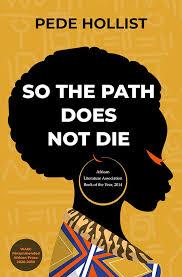
So the Path Does Not Die
The content of the novels on this website is provided as summaries to assist with revision. Candidates should ensure they read and fully understand all the relevant novels before the exams.
So the Path Does Not Die
Chapters 10-14
Chapter 10
The Sierra Leonean Civil War enters the narrative’s present when Fina receives a frantic call: rebels have invaded Freetown, forcing her sister Isa to flee. This event shifts Fina’s financial role from "helping" to a desperate penance for survival. A major Theme of Guilt emerges when Fina sends Isa's family to Guinea by a cheap refugee barge; hearing reports of starving, drifting vessels, she fears her frugality has led them to a "watery death." This burden of the Diaspora creates Cultural Friction with Cammy, who views Isa as "taking advantage" of Fina. Their clash highlights the divide between Fina’s communal African mantra—"not to cut the rope"—and Cammy’s Western, individualistic focus on self-support.
The tension deepens over a physical detail: Fina’s overbite. When Cammy suggests braces to "fix" it, Fina is deeply offended, viewing the overbite as a symbol of her authentic African self. She sees his suggestion as a subtle attempt to further Westernise her. However, a resolution appears through Fina’s pregnancy. They decide to name the child Dimusu-Celeste, a "dual heritage" name that blends Fina’s African roots with Cammy’s Caribbean lineage. This "New Path" represents the successful integration of identities, suggesting a future where the path does not die but evolves.
Chapter 11
On her wedding day, Fina is haunted by a vivid nightmare of her aborted initiation, filled with ghostly figures and chanting. This Symbolism of the Dream suggests that, despite her American success, she remains tethered to an "incomplete" past and the ominous weight of her grandmother’s traditionalism. When Cammy arrives, he dismisses her anxieties as superstition, urging a rationalist view of life as a "series of beginnings and endings." This Character Conflict is further emphasised by Cammy’s obsession with a "perfect" surgical robot, which stands in stark contrast to the messy, emotional reality of Fina’s human obligations.
The Burden of the Diaspora is punctuated by a final call from Isa in Guinea. The call juxtaposes Fina’s lavish wedding preparations with Isa’s reality of eating rice and palm oil. Fina is forced into a "double exile," where her personal joy is perpetually tempered by the survival needs of her kin. Ultimately, Fina resolves to pay for Isa's computer course, choosing to adhere to her cultural mantra of shared responsibility even as the professional wedding planners from "Wedplan" begin to transform her into a Western bride.
Chapter 12
The wedding serves as a massive affair, costing $40,000 and acting as an "open house" where immigrants construct a shield of material success against the "stranger condition." The detailed imagery of fabrics—Ghanaian Kente, Nigerian Adire and Sierra Leonean lappas—highlights the fierce preservation of African identity in the Diaspora. However, beneath this colourful exterior, Intra-Diaspora Conflict brews. Outside the church, the "Man Dem" (African men) clash with Kizzy, who expresses an "utter love" for America as an escape from the "fucked up" reality of his home country.
Tensions escalate when Cammy’s childhood friend from Trinidad, "Scraps" Ramjohn, attempts to push through the African "nuptial defensive line." This confrontation illustrates the deep-seated friction between Caribbean and African identities. The Character Arc of Cammy takes a negative turn when he breaks up the scuffle; his "sneering" disdain for the African guests and his mockery of the Civil War rebels reveal a high-handed lack of empathy. His stinging insults deflate the celebratory mood, signalling a disconnect between his medical elite status and the lived struggles of his guests.
Chapter 13
Fina walks down the aisle alone, a powerful image of her status as a woman without a biological family in America. Her bouquet of sunset-colored roses symbolises a mature, tempered love. However, the ceremony is shattered by the Return of the Past when Jemal, her husband from Chapter 7, stands up to declare they are not legally divorced. This reveal proves that Fina’s "gain" (her green card) was built on a legal foundation she had not properly dismantled. Overwhelmed by shock, Fina flees the altar—a recurring physical manifestation of her psychological habit of fleeing trauma.
The church descends into a debate over morality, exposing the Irony and Hypocrisy of the congregation. Kizzy, himself a man with deep secrets, is the first to judge Fina, claiming "what’s done in the dark must come to light." Jemal continues to mock Fina’s heritage, calling her bigamy "juju mess." This climax reveals that every member of this "gathering of tribes" is carrying hidden baggage, and Fina’s attempt to start a new life has been derailed by the very survival tactics she used to stay in the country.
Chapter 14: The Death of the Union
Inside the vestry, the conflict shifts to Secrecy vs. Logic. Cammy is explosive with embarrassment, viewing Fina’s silence about her past marriage as a cold deception. Fina, operating on the guarded intuition born from her trauma, reveals she had a "bad feeling" and had secretly brought her divorce decree to the church. Outside, the "public image" of the wedding completely disintegrates into a physical brawl involving Jemal, Scraps’ crew, and even local white residents. The "hallowed church grounds" are profaned, confirming the prejudices of onlookers who view the Black congregants as "lowlifes."
The chapter highlights Cultural Superiority through Cammy’s mother, Celeste, who dismisses Fina’s traditional wailing as "voodoo gibberish" and demands she "pull herself together." This interaction underscores the disdain Cammy’s family feels for Fina’s "unrefined" African expressions. The union officially dies when Cammy refuses to continue the wedding, accusing Fina of a lack of trust. Fina, in turn, critiques his "smugness" and inability to understand the defensive, "guarded" nature of a migrant's life. The act ends with Cammy storming out, leaving Fina in deep sorrow as her dreams of a stable American life collapse.