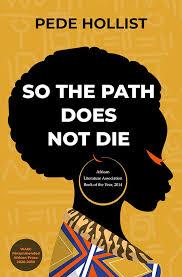
So the Path Does Not Die
The content of the novels on this website is provided as summaries to assist with revision. Candidates should ensure they read and fully understand all the relevant novels before the exams.
So the Path Does Not Die
Chapters 15-19
Chapter 15
In the aftermath of the failed wedding, Fina experiences a profound internal reckoning, tracing her "marathon" of misfortune back to the spiritual weight of her grandmother’s curse and her "aborted initiation." This chapter explores a deep Theme of Belonging; Fina realises that moving to America did not grant her sanctuary but merely traded one set of prejudices for others, such as the labels of "black, African, and alien." Her critique of the "Hypercrap"—the systemic stress and paranoia unique to the Black immigrant experience—serves as a sharp sociological commentary on the psychological toll of the West. Ultimately, Fina’s decision to pack her bags marks the climax of her Bildungsroman. She chooses the emotional "comfort zone" of home over the material climate control of America, seeking a life where her internal identity finally matches her external environment.
Chapter 16
The narrative shifts to the Theme of public vs private as voyeuristic guests gather at Cammy’s house to reconstruct the lore of the wedding disaster. Cammy, retreating into a scientific and logical worldview to cope with his shame, is confronted by his own origin story: his obsession with medicine began with the death of his brother, Donovan. In a moment of massive thematic irony, a young man named Glen appears, claiming to be Cammy’s son. This suggests that Cammy’s past is just as "sordid" as the one he judged Fina for harboring. Simultaneously, Kizzy faces systemic injustice in an "egg-white" interrogation room, accused of manslaughter. The plot draws the characters into a web of interconnectedness, as Kizzy’s only hope for legal survival lies with Cammy, the man he once unknowingly wronged by raping Fina.
Chapter 17
Fina’s transformation is signalled through Sensory Imagery; she no longer dreams of American success but longs for the smell of ogiri and the "mosquito whine" of Sierra Leone. This shift indicates that her internal exile is ending. She frames her return as a ritualistic necessity to "mend the broken rope" with her heritage, believing her bad luck stems from her father’s "taboo" act of snatching her from the initiation bush. Fina revisits the myth of Musudugu, viewing it now as a sanctuary of female solidarity against the "smugness" of men. The narrative transitions from a romantic quest to a celebration of female communal strength, as Fina realises that "absorbing each other’s pain" is the true path to survival, leading her to help even those who have hurt her, like Kizzy.
Chapter 18
Cammy discovers that his mother, Celeste, orchestrated the disappearance of his high school girlfriend and the adoption of his son, Glen, to protect his "future." This revelation is a Mirror of Hypocrisy; the same family pride Cammy used to judge Fina was actually used to hide his own secrets. In a stroke of thematic irony, Glen is the "spitting image" of the brother Cammy lost to renal failure and is now dying of the same disease. When Cammy attempts to apologise to Fina, his shift into formal, "British-accented" English acts as a style barrier, showing his struggle to communicate through his education rather than his soul. Fina rejects his view of Sierra Leone as "insane," arguing that American insanity is simply more pervasive and soul-crushing. She teaches him that "love is about sacrifice," redefining their relationship as a shared mission of healing.
Chapter 19
The symmetry of Fina and Cammy's secrets finally dissolves their mutual indignation, as both accept that the immigrant condition involves a past that eventually unravels. Fina insists that Cammy must donate his kidney to save Glen, referencing her own father’s bravery in the Fafei to prove that "real fathers sacrifice themselves." By agreeing to this and testifying for Kizzy, Cammy moves from a man of "logical science" to a man of human sacrifice and communal responsibility. Just as they attempt to reclaim their intimacy and find a sense of "oneness," Fina’s body betrays her. Her mounting stomach pains culminate in a medical emergency, serving as a physical manifestation of the trauma and the "broken rope" she has yet to fully mend.