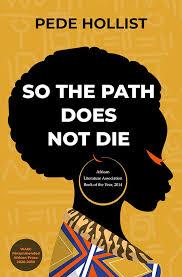
So the Path Does Not Die
The content of the novels on this website is provided as summaries to assist with revision. Candidates should ensure they read and fully understand all the relevant novels before the exams.
So the Path Does Not Die
Background, Synopsis, Settings
Author's Background
Pede Hollist (born Arthur Onipede Hollist) is a prominent Sierra Leonean scholar and author whose career bridges the gap between West African heritage and Western academia. He currently holds the position of Associate Professor of English at the University of Tampa, Florida. Hollist specialises in what he calls the "literature of the African imagination," a field encompassing creative expressions from both the African continent and the global Diaspora.
Hollist’s literary journey began with short fiction; his story "Foreign Aid" earned him significant recognition when it was shortlisted for the Caine Prize for African Writing in 2013. His first novel, So the Path Does Not Die, was released in the U.S. in 2008 and saw broader distribution across Africa by 2012.
His bibliography is characterised by a deep exploration of the "in-between" experience: characters caught between different geographies and cultures. His writing centres on four major areas:
-
African Identity: Defining the African self within a globalised, shifting landscape.
-
Migrancy: Examining the physical and mental toll of the "BackHomeAbroad" phenomenon.
-
Social Justice: Tackling provocative issues, including Female Genital Mutilation (FGM), systemic racism and gender inequality.
-
Cultural Preservation: Balancing the revival of African nationalism with the necessity for individual progress.
Textual Background
So the Path Does Not Die is a female Bildungsroman (a coming-of-age narrative) that follows the protagonist, Finaba (Fina), as she matures from childhood to adulthood. The story is set in an Africa undergoing a forced transition toward Westernisation, a process Hollist describes as being "hoisted" upon the continent.
The novel draws inspiration from the literary traditions of authors like Chinua Achebe, focusing on the friction between ancient customs and modern pressures. It serves as a feminist narrative, detailing Fina’s quest for economic and social autonomy while navigating the trauma of childhood circumcision and the patriarchal constraints found in both rural villages and urban cities.
The title serves as a central metaphor for the preservation of African civilisation. Hollist suggests that the "path" of tradition must be nurtured and evolved into a life-affirming form to prevent it from being erased by globalisation.
The novel’s structure reflects the reality of the modern African Diaspora by linking three distinct regions:
-
Africa: Where the journey begins and ultimately concludes.
-
The United States: Representing the immigrant experience and the search for a new identity.
-
The Caribbean: Adding another layer to the complex "hybrid world" of the African imagination.
Synopsis
The novel opens with the myth of Musudugu, a feminist utopia where women lived in total prosperity and harmony under the deity Atala. In this paradise, men were excluded or strictly regulated. The legend focuses on Kumba Kargbo, a woman born breech—a sign of her future defiance. Kumba’s thirst for knowledge caused her to grow into a literal giant, but her size eventually became a curse; she inadvertently destroyed her village by trampling it. This myth serves as a prefigurement for the protagonist, Finaba (Fina), signalling that she is destined to break tradition, even at a great personal cost.
The main story begins in Talaba, Sierra Leone. Fina’s parents, Amadu and Nabou, are wary of female circumcision after losing their first daughter to the rite. However, Fina’s grandmother, Baramusu, secretly arranges for Fina to undergo the ritual. In a moment of extreme sacrilege, Amadu invades the sacred Fafei (shrine) to rescue his daughter, taking her to a clinic instead. This act of defiance forces the family to flee the village for the capital, Freetown.
In Freetown, the family faces ethnic discrimination for being Fula and struggles with the harsh, individualistic city life. After her father dies of tetanus, Fina attends Crowther College, where she endures bullying and a traumatic sexual assault by a lab technician named Kizzy. Broken, she flees to the diamond town of Koidu, where a merchant named Sidibe Kakay sponsors her move to the United States.
In America, Fina's life is a search for a sense of belonging. She enters a green-card marriage with Jemal, an abusive drug addict. After their divorce, she finds love with Cammy, a urologist from Trinidad. Their relationship sparks a deep internal debate over her heritage; while she initially defends circumcision against Western "bigotry," she eventually acknowledges her own trauma. This realisation inspires her to return to Sierra Leone to help girls affected by the practice.
Returning to a post-civil-war Sierra Leone, Fina finds Talaba in ruins. She adopts a traumatised girl, Mawaf, and gives birth to a daughter, Dimusu-Celeste. The child’s name represents a hybrid identity—the merging of African and Western worlds. The novel concludes with Fina rewriting the Kumba Kargbo legend: in her version, men and women work together to rebuild. By opening her rehabilitation centre, Fina ensures the African "path" survives by evolving into a more inclusive and life-affirming journey.
Settings
Physical Settings
The novel spans a vast geographic range, highlighting the friction between tradition and globalisation:
-
Musudugu: A fictional, mythic utopia representing a pure, though flawed, feminine past.
-
Talaba: A rural landscape defined by Fula customs and communal living.
-
Freetown: An individualistic urban centre, specifically Crowther College, which symbolises both intellectual growth and deep personal trauma.
-
Koidu: A transit point in the diamond-rich Kono district that provides Fina the means to escape.
-
The United States: A "Diaspora" space ranging from white missionary circles to the affluent Black international elite.
Temporal Setting (Time)
The narrative is anchored in the 21st Century but relies on 20th-century historical markers:
-
The 1980s: Marked by the family’s move to Freetown during the OAU conference era.
-
1991–2002: The Sierra Leonean Civil War, which serves as the backdrop for the destruction of Fina’s home and the displacement of her people.
-
The Early 2000s: The "present day" of the novel, focused on post-war recovery and identity building.
Psychological Setting
The mental landscape of the novel is one of tension and fragmentation. Fina exists in a "hybrid world"—a state of mind common to migrants who feel caught between two worlds. Her psychological journey is defined by:
-
The Struggle for Supremacy: The internal war between ancient African values and modern Western demands.
-
The Quest for Belonging: Healing the scars of sexual assault and the "aborted initiation" of her youth.
-
Cultural Synthesis: Moving from a state of being "torn apart" to forging a personalised path that honours both her heritage and her individual growth.