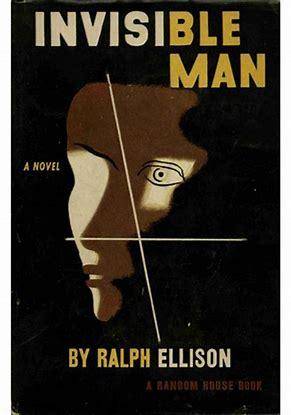
Invisible Man
The content of the novels on this website is provided as summaries to assist with revision. Candidates should ensure they read and fully understand all the relevant novels before the exams.
Invisible Man
Chapter 16
In the evening, Brother Jack and a group of men arrive in a taxi to take the narrator to Harlem. The narrator is nervous about delivering a speech. He follows Jack into the dressing room of an arena. Jack informs him that they will wait for the crowd to grow before proceeding. He asks if the narrator has reviewed the Brotherhood material and advises him to observe the other speakers before taking his turn. The narrator, slated to speak last, spends his time examining a photo of an old boxing champion. It stirs a memory of a story his father once shared, and he is struck by the irony of ending up in the same arena. Though uneasy, the narrator realises he must now place his trust in the Brotherhood.
The narrator feels nervous and self-conscious. He can barely recognise himself. He perceives this moment as a transition into a new chapter of life, far removed from the humiliations of his past, yet he cannot ignore his grandfather's defiant voice echoing within him. Stepping outside to clear his head, he recalls a childhood memory of a derelict sports arena turned dumping ground. The image of a sickly man living nearby unsettles him, but he shakes off the memory as he notices mounted policemen in the alley. He decides to alert Brother Jack.
Inside, the audience grows louder and this makes the narrator more nervous. He recalls a childhood dog named Master, whom he liked but did not trust—a sentiment he now feels toward both the crowd and Brother Jack. As the noise crescendos, Jack ushers the speakers onto the stage. The spotlight blinds the narrator momentarily as the crowd breaks into song. Walking to the platform, he notices a lot of policemen around, but Jack assures him that the officers are there for protection. The rally begins, and the narrator initially attempts to recall key phrases from the earlier speeches but soon abandons this effort, allowing the crowd’s energy to propel him forward. A tug on his sleeve signals it is his turn to speak.
The narrator begins awkwardly as he struggles with the microphone, but quickly adjusts. He realises the crowd is on his side and shifts away from Brotherhood jargon. He delivers a passionate speech rooted in protest. The narrator tells the audience that certain people think they are “dumb” and “common.” The narrator offers the rejoinder that the people are uncommon because they let themselves be treated poorly. He turns to the subject of dispossession, telling the audience that if they don’t resist, their oppressors will succeed in dispossessing them.
The narrator says that everyone gathered has been dispossessed of one eye, causing them to see only in “straight white lines.” He tells the crowd that they are like two blind men walking down opposite sides of the street. When bricks start getting thrown, the two men blame each other, although there is a third man in the street throwing bricks at both of them. The narrator tells the crowd that if they band together, they will be able to see their way forward.
As he builds to a fervent climax, Brother Jack quietly warns him not to “end your usefulness before you’ve begun.”. Ignoring this, the narrator continues. He says that speaking before them has made him feel “more human.” Moved to tears, he ends with a rallying call for unity against dispossession. The audience erupts in thunderous applause. Several members of the Brotherhood congratulate the narrator.
Backstage, the atmosphere is not as positive. While some Brotherhood members praise the narrator, others do not. A man with a pipe criticises his speech as overly emotional and politically irresponsible. Brother Jack defends the importance of energising the public but agrees that the narrator must learn the Brotherhood’s “scientific” approach. It is decided that the narrator will temporarily step away from public engagements to be educated in the proper “scientific” terminology under Brother Hambro. The narrator is frustrated but Brother Jack assures him that such a period od “indoctrination” was inevitable.
The narrator returns home. Despite the criticism, he feels gratified by the crowd’s response and notes how different this speech was from his earlier attempts in college. He muses over the phrase “more human” and its meaning, recalling his college literature course and the figures of Bledsoe and Norton. With ironic laughter, he acknowledges that their actions inadvertently fuelled his rise, making him both significant and dangerous in ways they could never have foreseen.
Points to Note:
Although new to the Brotherhood, the narrator quickly learns there are rigid expectations for how its ideas should be communicated. By aligning himself with the Brotherhood, he distances himself from his past, yet remnants of his old self—particularly his grandfather's dissenting spirit—persist. This duality foreshadows the tension between his desire to conform and his innate scepticism toward blind loyalty.
The narrator’s speech reveals his natural charisma and ability to connect with his audience, a skill rooted in his past experiences. Rejecting the Brotherhood's clinical jargon, he taps into the emotive cadences of southern preachers and this resonates deeply with the crowd. However, the Brotherhood’s backstage reception highlights a disconnect between the movement’s leadership and the realities of engaging people on a visceral level.
The narrator's analogy of one-eyed blindness hints at a broader critique of the Brotherhood's ideological rigidity. It suggests that true progress requires collective vision and mutual understanding. His success with the audience contrasts sharply with the committee's disdain. This exposes a gap between public perception and internal politics. Ultimately, the Brotherhood’s decision to “educate” the narrator reflects its need for control. It prioritises ideological conformity over genuine connection.
Possible Questions
Multiple Choice Questions (MCQs)
-
What causes the narrator to feel uneasy before delivering his speech?
a) The loud crowd in the arena
b) His inexperience with public speaking
c) His grandfather’s dissenting voice echoing in his mind
d) All of the above -
Why does Brother Jack advise the narrator to step away from public speaking temporarily?
a) To focus on learning the Brotherhood’s "scientific" approach
b) To avoid criticism from the crowd
c) To recover from the emotional toll of the rally
d) To write a new speech for the next rally -
What metaphor does the narrator use, in his speech, to describe dispossession?
a) A one-eyed blindness
b) A two-headed serpent
c) A three-legged race
d) A dark tunnel -
What criticism does the narrator receive backstage after his speech?
a) His speech lacked energy
b) It was overly emotional and politically irresponsible
c) The audience didn’t understand him
d) He didn’t follow the planned script -
Why does the narrator feel “more human” after delivering his speech?
a) He realises his true purpose
b) He defies Brother Jack’s instructions
c) He connects deeply with the audience
d) He remembers his grandfather’s teachings -
What does the narrator’s laughter at the end of the passage signify?
a) Relief from his nervousness
b) Irony in how his past shaped his rise
c) Amusement at the Brotherhood’s teachings
d) Confidence in his newfound power
ANSWERS: 1. D 2. A 3. A 4. B 5. C 6. B
Theory Questions
-
What is the significance of the narrator’s analogy of one-eyed blindness? How does it relate to the Brotherhood and the broader theme of dispossession?
-
Discuss the significance of the narrator feeling “more human” after his speech. How does this sentiment contrast with the Brotherhood’s focus on ideological conformity?
-
How does the narrator’s use of emotive language during his speech enhance his connection with the audience? Why does this approach clash with the Brotherhood’s “scientific” methods?