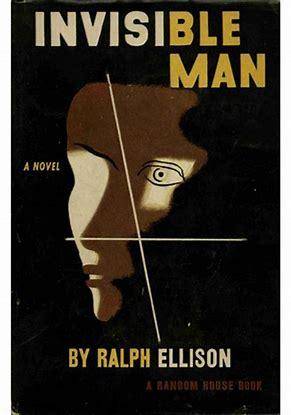
Invisible Man
The content of the novels on this website is provided as summaries to assist with revision. Candidates should ensure they read and fully understand all the relevant novels before the exams.
Invisible Man
Background, Plot, Settings, Themes, Characters
Background
Authorial Background
Ralph Ellison was born in Oklahoma City in 1914. His parents were resolute pathfinders who quit the Deep South to pursue the greater freedom of the American Frontier. They settled in the newly ratified state of Oklahoma. His father, Louis Ellison, had little formal education but he was intelligent, curious and a voracious reader. He named his first son after a favourite writer, Ralph Waldo Emerson. Ida Ellison was an independent strong-minded woman who once supported a socialist candidate for governor of Oklahoma and campaigned to keep Oklahoma free from segregation. Their ice and coal business was thriving until tragedy struck. Louis Ellison slipped while carrying a block of ice which shattered and sliced into his sides, He was dead in a month, He died when Ralph was only three years old. His death plunged the family into poverty. Ida would work as a domestic for the rest of her life. The family became near-nomads as they moved from one house to another.
Ellison described his childhood as deeply painful. He began to stammer, a habit that he never fully conquered. Ida Ellison was determined that Ralph and his brother Everett would live lives of possibilities. On Sundays, she took the boys working through white neighbourhoods to give them glimpses of a better life. From the houses she cleaned, she brought home discarded toys, opera records and copies of Vanity Fair magazines which Ellison read, stacked and kept neatly into adulthood.
As a teenager, Ellison had an extravagant ambition to become what he called a “Renaissance man” - a master of a broad range of skills to overcome any adversity and drive his one fate. He worked odd jobs to dress in the Ivy League style he saw in magazines, played football and read a great deal. Music was his passion. Immersed in the musical culture of Oklahoma City, he resolved to make the most of it. For the first time artists like the poet, Langston Hughes, the writer, Zora Neale Hurston and some painters of the time, gave American audiences sophisticated representations of Black lives and culture.
Ellison graduated from Frederick Douglas High School in 1932, Fortified by multiple talents, he eagerly planned to go to college, become a composer and write a symphony based on the blues but, in Ellison’s youth, racial segregation spread to Oklahoma from neighbouring Texas and Arkansas. In 1921, a white mob in Tulsa incited a race riot and torched much of the Negro business and residential districts. Legalised segregation foiled Ellison’s plan to attend the University of Oklahoma. His parents' dream had become a nightmare. Oklahoma had become the Deep South. Hoping for any opportunity, Ellison had worked for a year building a wardrobe and buying a trumpet.
Finally, Zelia Breaux, Ralph’s high school music teacher, secured a scholarship to Tuskegee Institute in Alabama to study under the acclaimed composer, William Dawson. Ellison was enthusiastic but also broke and had to report to the Institute in two days. He had to hop on a freight train, a dangerous thing for a black man to do at the time. In his pocket, he carried a few dollar bills and a switchblade. Ellison arrived at the Institute with a scar and a cut on his forehead. Ellison excelled in the Institute’s rigorous programme.
Ever the Renaissance man, he also acted in school plays and dabbled in poetry. In his sophomore year, he read T.S. Eliot’s long complex poem, “The Waste Land”. Delving deeper into literature, Ellison paid less attention to his music courses jeopardising his scholarship. At the end of his junior year, he boarded a train to New York hoping to find a summer job to save money for his senior year. He never returned to Tuskegee as a student.
In New York, he met Langston Hughes. Hughes took Ellison under his wings. In 1937, Hughes introduced Ellison to Richard Wright who was active in the communist party. Ellison became a protegee of Richard Wright. Ellison was drawn to fiction but stuck mainly to reviews on newspaper magazines and publications. Around 1940, Ellison began to practise fiction writing like he did with music. Ellison was also encouraged by the explosive success of Richard Wright’s powerful first novel. Native Son was the definitive protest novel of Black America. It shocked the nation into confronting the brutal realities of black lives. However, Native Son also triggered a maelstrom of controversy as people thought that the novel’s hero was a stereotypical representation of the blacks
Though Ellison tried to defend the book, he had begun to question whether protest literature revealed the complexities and richness of everyday negro life as he experienced it. Ellison's growing literary maturity was confirmed in 1947 with the publication of a story titled Invisible Man. The first chapter was published in the American Horizon and was titled “The Battle Royale” which alerted an enthusiastic literary audience that something special might be coming but Ellison proceeded painstakingly. By this time, Ellison had met Fanny McConnell. They shared a love of literature and were married in 1946. Fanny remained Ellison’s partner for the rest of his life and her moral and financial support allowed him to devote the next five years to completing his novel. Finally, in 1952, Invisible Man was published.
Textual background
Ralph Ellison’s Invisible Man was written against the backdrop of the Black American experience in American society. The Narrator of the novel embarks on a journey in search of visibility and success and documents his discovery along the way. Ever since their emancipation in the 1860s, they have been faced with racial segregation and discrimination and political and economic backlash. Ellison attempts to portray how the Black man searches for a stable identity in the face of all these. The years leading to the Emancipation Proclamation were met by a great division between the Northern and Southern parts of the United States of America. While the northerners advocated for the freedom of the blacks from their slave masters, the blacks still wanted slavery to go on as they benefited most from this enterprise. They needed black slaves to work in their plantations as the plantations contributed a great deal to their economy. With the Emancipation Proclamation by the then-president of the United States of America, Abraham Lincoln, the black slaves were free from their masters. The white southerners began to bear a lot of resentment against the blacks and sought to oppress them. New laws were set in place by the white southerners to ensure that the blacks remained indentured slaves and labourers for life. Laws like the Jim Crow Laws and sects like the Ku Klux Klan, an American white supremacist hate organisation, which was founded in 1866, were put in place to ensure that African Americans did not have the same rights as whites had. They attended segregated schools, patronised segregated stores, took segregated buses, lived in segregated neighbourhoods and rented segregated apartments. All these facilities were substandard and mainly unaffordable to most blacks. Lynching (public/ mob execution of supposed wrongdoers) of blacks was commonly practised around the time.
Many African Americans had to contend with racism daily, in a society that relegated them to the fringes where they were regarded as intellectually and racially inferior to white people. African Americans who managed to rise up the social ladder were people who were ready to play second fiddle and embrace the white world’s hegemonic structure for American society. For instance, Booker T. Washington, a notable African American, was famous for his Atlanta Compromise speech which was tailored to satisfy the desire of the whites. He summarily advised his fellow black compatriots to drop the agitation for social equality and focus instead on developing themselves as artisans. They should be content with the little opportunity that they have with the educational advancement that has been given to them and not ask for more. His views that African Americans should remain subservient to whites made him acceptable to them, who promoted his controversial postulations about African Americans.
The blacks, who could no longer bear the resentment of the white southerners, migrated to the north where the environment was a little more hospitable for them to develop their own business. Between 1916 and 1930, there was a mass migration of blacks from states in the deep South to these more hospitable states. This mass migration is commonly described as the Great Migration.

The Great Migration led to what is popularly regarded as the Harlem Renaissance. The most common destination for these southern migrants at the time was the Harlem district in New York. The increased concentration of black intellectuals and artists led to a faster spread of ideas and an increased output of works.
Plot Account
Ralph Ellison’s Invisible Man (1952) follows the journey of an unnamed African American narrator as he struggles to find his identity in a racially prejudiced American society. The novel is a first-person account of his experiences from the rural South to the urban North, highlighting themes of race, identity, and social invisibility.
The narrator, now living in an underground basement illuminated by hundreds of light bulbs powered illegally from the city’s grid, introduces himself as an “invisible man.” He explains that his invisibility is not physical but societal—people refuse to truly see him because of his race. He recounts past experiences that led him to this state of isolation.
As a young man, the narrator is an eager student at a Black college modeled after Tuskegee Institute. He is invited to deliver a speech to a group of white elites in his hometown but is first forced to participate in a humiliating “battle royal,” where he and other Black boys fight blindfolded for the entertainment of the white men. Despite the ordeal, he delivers his speech and receives a scholarship to the prestigious Black college.
At the college, he is assigned to chauffeur a white trustee, Mr. Norton, around the campus and nearby areas. They visit the home of Jim Trueblood, a poor Black man who has impregnated his daughter, and a chaotic Black bar, the Golden Day. Mr. Norton is horrified by these realities and blames the narrator for exposing him to them. The college president, Dr. Bledsoe, expels the narrator for embarrassing the institution, though he pretends to help him by giving him letters of recommendation for jobs in New York.
In New York, the narrator discovers that Dr. Bledsoe’s letters are actually warnings that prevent him from getting employment. Desperate, he takes a job at Liberty Paints, a factory known for its slogan, “Keep America Pure with Optic White.” He is assigned to work under a hostile foreman, Lucius Brockway, who sees him as a threat. A workplace accident lands him in the factory hospital, where he undergoes painful electroshock therapy, symbolic of society’s attempt to erase his identity.
After recovering, he wanders through Harlem and delivers an impromptu speech at an eviction protest. This attracts the attention of the Brotherhood, a political organization claiming to fight for racial and economic justice. The group recruits him as a spokesperson and this gives him a new sense of purpose and recognition.
The narrator rises within the Brotherhood and gains influence while refining his rhetorical skills. However, he soon realizes that the organization is using him as a token figure rather than truly advocating for racial equality. Internal power struggles and ideological conflicts lead to his demotion.
Meanwhile, a former ally, Ras the Exhorter (later Ras the Destroyer), emerges as a militant Black nationalist who condems the Brotherhood for its manipulation of Black people. Tensions in Harlem escalate, culminating in a violent riot. As chaos erupts, the narrator is attacked by Ras, who calls for his death. The narrator flees and falls into a manhole, symbolically retreating from society.
Hiding in his basement, the narrator reflects on his journey and the contradictions of race and identity in America. He acknowledges that he has spent his life trying to fit into roles imposed by others and decides that true freedom comes from embracing his invisibility and defining himself on his own terms. Though he remains underground, he hints at emerging one day with a new understanding of his identity.
Settings
Invisible Man by Ralph Ellison is set in 20th-century America, with two main geographical settings: the South and the North. The South, the Narrator’s place of origin, is a region marked by its history of slavery, racial segregation, and the systemic oppression of black people. In this environment, black individuals are dehumanised and subjected to widespread discrimination.
The North, particularly New York, serves as the backdrop for the novel's second part. During the period in which the novel is set, migration from the South to the North symbolised progress and freedom for African Americans. The Narrator embarks on this journey with aspirations of working for a year to save money before returning to college. However, his plans are derailed. His experiences with the Brotherhood, for instance, occur entirely in the North, primarily in New York and Harlem. In Harlem, his hopes are crushed, and the illusions associated with Northern life—represented by New York—are shattered. Through these trials, the Narrator undergoes a rebirth, ultimately recognising the pervasive injustice and racial oppression that define the world.
The novel also features specific, significant settings, including:
- The all-black college in the South, where the Narrator’s journey begins.
- The streets of Harlem, central to the events in the North.
- Mary Rambo’s house, a place of temporary refuge.
- The Liberty Paint Factory, where the Narrator works and faces symbolic challenges.
- The headquarters of the Brotherhood, which represents false promises of equality.
- An underground hideout, from where the Narrator reflects on his experiences and narrates the story.
Themes
Ralph Ellison’s Invisible Man is a deeply symbolic novel that explores themes of race, identity, invisibility, and societal oppression. The protagonist's journey from an idealistic young man to a self-aware individual who understands his invisibility highlights the struggles of Black individuals in America. Below are the major themes of the novel, with detailed examples from the text.
Invisibility and Identity
The theme of invisibility is introduced in the Prologue, where the narrator states:
"I am invisible, understand, simply because people refuse to see me."
His invisibility is not physical but a metaphor for how Black people in America are overlooked, misrepresented or denied an identity. Throughout the novel, the narrator struggles with defining himself, as others impose identities upon him.
The "battle" royal in chapter one of the novel clearly depicts this invisibility. The narrator is invited to give a speech to a group of white men, but before he can speak, he is forced to participate in a humiliating "battle royal," where young Black men fight for the entertainment of the white elite. This scene illustrates how Black individuals are seen as sources of amusement rather than intellectual beings. Even after enduring the battle, his speech is ignored. This higlights how his voice is not truly heard.
The manipulation of the Narrator by the Brotherhood also depicts this invisibility. The Brotherhood claims to empower the narrator, but they only use him as a symbolic figure. They write his speeches and dictate his actions. They treat him as a tool rather than a person with independent thought. When he begins to think for himself, he is discarded.
In the end, the narrator retreats underground after the realisation that society refuses to acknowledge him as an individual. By embracing his invisibility, he gains the power to define himself on his own terms.
Racism and Systemic Oppression:
The novel critiques the systemic racism embedded in American society, showing how Black people are exploited, controlled, and manipulated.The narrator's relationship with Dr Bledsoe helps to exemplify this. The narrator idolizes Dr. Bledsoe, the Black college president, believing him to be a symbol of Black success. However, Bledsoe betrays him by sending him to New York with fake recommendation letters. Bledsoe represents the idea that some Black leaders maintain power by appeasing white society rather than challenging racism.
The incident at Liberty Paints Factory also helps to portray the systemic racism and oppression inherent in 20th-century American society. The narrator works at a factory that manufactures "Optic White" paint, a symbol of white dominance. The paint’s formula requires a few drops of a black substance to become its "purest" form. This symbolises how Black labour is necessary but unacknowledged in white society. His job ends in disaster when he is injured in an explosion and subjected to electroshock therapy which erases his identity further. .
During the riot in Harlem, after the Brotherhood uses and discards the narrator, he realizes that Harlem has descended into chaos. White authorities allow destruction to continue. This reinforces the idea that Black communities are expendable and their struggles are ignored.
Betrayal and Exploitation:
Throughout the novel, the narrator is repeatedly betrayed by individuals and institutions he trusts. Each betrayal forces him to question his beliefs and identity. Dr Bledsoe is one of the individuals who betrays him. Instead of supporting the narrator, Dr. Bledsoe expels him and sends him to New York with fake recommendation letters to ensure that he remains powerless. The Brotherhood initially presents itself as a progressive organization, but it only exploits the narrator for its own political agenda. When he starts developing his own ideas, they abandon him. Ras, a Black nationalist, sees the narrator as a traitor for working with the Brotherhood and eventually incites a riot against him. This reveals the divisions within Black political movements and the challenges of unity in fighting racial oppression.
The Illusion of the American Dream
The narrator initially believes in the American Dream—the idea that hard work and education lead to success, regardless of race, ethnicity or economic status. However, he gradually realizes that racial barriers prevent true upward mobility for Black individuals. The narrator is given a scholarship after being degraded in the battle royal. This suggests that education is only granted to Black individuals who conform to white expectations. The narrator believes he will find success in the North but is met with more exploitation at the Liberty Paints factory. The Brotherhood appears to offer a path to influence, but in reality, it is just another institution that controls and discards Black individuals.
The Search for Self-Definition
At its core, Invisible Man is about the struggle for self-definition in a world that refuses to acknowledge Black individuality. The narrator’s journey from blind faith in society to the realization of his invisibility highlights the complexities of race, power, and personal identity. By the end of the novel, he embraces his invisibility not as a weakness but as a form of empowerment. His final statement—
“Who knows but that, on the lower frequencies, I speak for you?”
—suggests that his story is not just his own but representative of the struggles of many Black individuals in America.
Ellison’s novel remains a powerful critique of racial and social injustice and this makes it one of the most significant works of 20th-century American literature.