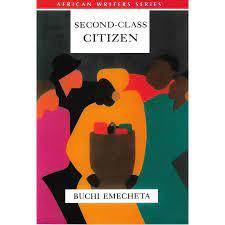
Second Class Citizen
The content of the novels on this website is provided as summaries to assist with revision. Candidates should ensure they read and fully understand all the relevant novels before the exams.
Second Class Citizen
The Collapse
- Adah’s worst fear happens when she is pregnant again. She consults their family’s regular doctor, an Indian man, and pleads for the termination of the pregnancy.
-
He tells her that he should have asked him for the cap as the clinic’s caps are cheap. He gives her some white pills. Adah supposes that the pills will induce abortion and decides not to tell Francis about the situation. This is because she believes that Francis has a tendency to spread the news of the intimacy of their household to those who have no business with it.
-
Adah reflects on her childhood difficulties which revolved around surviving and getting an education while all alone. She hoped marriage would give her a partner and solely responsible for the children. Yet she is determined to survive.
-
Adah starts working at a new library, the Chalk Hill Farm library. There, she has several coworkers, including Peggy, whose heart was broken by an Italian boy; the boss, Mr Barking, a grump who hates his son-in-law, whom he believes is cruel to his daughter; and Eileen, the children’s librarian. There is also Eileen's Canadian husband Bill, who starts recommending Adah books by Black authors.
-
Adah and Bill become friends. She trusts men more easily because her Pa was so reliable. Adah also makes all her coworkers like her. She enjoys hearing their problems, which help her ignore her own.
-
Husband and wife fight all the time. We are told that “Mr Noble was fed up with their fights and had asked them to move” (p. 168). As if that was not enough, all the women in Mr Noble’s house write to Adah “begging her to control her husband because he was chasing them all” (p. 168)
-
Three months later, Adah realises that the pills the doctor gave her had not worked. She goes to the doctor to confront him. The doctor replies angrily: “I did not give you the pills to abort the child.” Adah threatens with, “if my child is imperfect in any way, you are responsible. You know that”
-
Adah leaves the clinic and walks to a park to reflect. She worries that the child would be imperfect and that her in-laws will believe she had an affair. After hearing about the letter Francis sent his parents about her desire to use contraception, Boy had sent all his savings, insisting she leave Francis and return to Nigeria to retake her job at the Consulate.
-
As she sits in the park reflecting, a black man taps her shoulders and speaks to her. She realises that he is Ibo. The man introduces himself as Mr Okpara. He asks her if she had had a fight with her husband before. His approach of settling the misunderstanding between Francis and Adah is: “Let’s go and beg his forgiveness. He would let you in” (p. 170). This is the Igbocentric approach of containing family feud.
-
Though Adah is annoyed at the characteristically Ibo presumption that the wife is the one who did something wrong, Adah leads him to her apartment.
-
When Adah and Okpara enter the apartment, an unshaven Francis is singing a Jehovah’s Witness hymn to Bubu while Vicky swings his dirty diaper around and Titi watches.
-
Francis tells Okpara that he never hit Adah. Okpara tells Francis that Adah is miserable, which is risky in the UK, where there is no one to talk to. He predicts that Adah could have a mental health crisis and asks whether Francis would want to pay the bills for that.
-
Both Adah and Francis are shocked by Okpara’s assumption that Francis pays the bill. Francis “lashed his tongue at Okpara, told him to go back home and mind his own business” (p. 173).
-
However, Mr Okpara, being an Igbo man at heart does not feel insulted nor does he leave immediately. He tells France that until he gets a job and starts supporting his family, his son won’t respect him.
-
When Adah is five months pregnant, she tells Francis about the baby. He laughs at her cruelly. The Indian doctor becomes Adah’s strongest ally. He apologises for misinforming Adah about the drug he had given her.
-
Instead of giving Francis her pay for him to dole out two pounds for housekeeping, “she would buy everything the doctors and the midwives told her to eat” (p. 175). Francis insists that she put her refusal to give him money in writing and she does so.
-
Adah gives birth to their fourth child,a girl named Dada, who arrives without much trouble compared to Bubu. Grateful for Dada’s health and beauty, Adah nicknames ehr “Sunshine”. Francis refuses to pick her up from the hospital so she gets a taxi home.
-
Francis eventually gets a job at the post office. He pays the rent and gives Adah two pounds to buy groceries for the entire family and keeps the rest of his money. Adah tells him that she will do the same: pay for all the children;s expenses and keep her money.
-
Since Francis is paying the family;s rent, Adah keeps doing his laundry and sleeping with him.. While breastfeeding Dada, Adah works out a daily schedule for herself and realises she has exactly three free hours a day.
-
She remembers her old aspiration to write and uses this time to complete her first novel draft that she calls The Bride Price.
Possible Questions
-
Why does Adah refuse to give Francis her earnings after the birth of Dada? A. She wants to save for her children’s education B. She no longer trusts Francis with financial responsibilities C. She needs the money to take care of her children D. She believes it is time for Francis to support the family
-
What is the significance of Adah’s nickname for her daughter, “Sunshine”? A. It highlights her hope for Francis to change B> It reflects her optimism despite challenges C. It symbolises her desire for freedom D. It signifies her cultural connection to Nigeria
-
What advice does Mr Okpara offer to resolve the conflict between Adah and Francis? A. Adah should leave Francis and return to Nigeria B. Adah should beg Francis for forgiveness C. Francis should respect the Igbo traditional values D. Adah should seek legal counsel
ANSWER: 1. C 2. B 3. B
Theory Questions
-
Reflect on Mr Okpara’s role in the narrative. How does his intervention represent cultural values and what impact does it have on Adah and Francis’ relationship?
-
Adah’s resilience is a recurring theme in the narrative. How does her reaction to challenges demonstrate her personal growth?