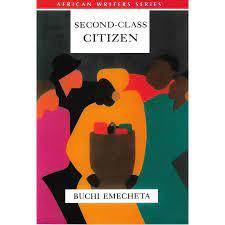
Second Class Citizen
The content of the novels on this website is provided as summaries to assist with revision. Candidates should ensure they read and fully understand all the relevant novels before the exams.
Second Class Citizen
Escape into Elitism
- Adah’s dream of going to the United Kingdom faces a devastating setback with the sudden death of her father, Pa who was the only family member eager to enroll her in school. This happens soon after she begins schooling at Ladi-Lak.
-
As it is in the Igbo custom, the family is divided among relatives after Pa’s death. Ma is inherited by Pa’s brother, while Adah goes to live with her maternal uncle as a domestic servant. Her brother Boy is sent to stay with Pa's cousin.
-
The family's financial resources are directed towards Boy's education, while Ma's brother reluctantly allows Adah to continue her schooling when a family member points out that an educated daughter will fetch a higher dowry when she marries — a portion of which will also contribute to Boy's education (p. 18)
-
She wakes up at 4:30 every morning and starts making trips to the public tap to fetch water for the entire household. At 6:30, her Ma’s brother goes to work, where he has Adah run errands for him.
-
The older male children of her uncle treat her as an unpaid servant. But, rather than see this challenging circumstance as a misfortune, Adah embraces the opportunity to become independent and responsible at a young age.
-
When Adah reaches the age of 11, discussions about arranging her marriage begin, and she desperately tries to drive away potential suitors through her unruly behaviour. Over time, she notices the number of suitors dwindling. She discovers this is because of her appearance. She acknowledges her unattractiveness, admitting she was "ugly then, all skin and bone."
-
One day, when Adah is at school, the headmaster tells the students about the secondary schools they can apply to enter, the Presence (that first appears to her after Lawyer Nweze’s arrival) speaks to her: “You are going, you must go and to one of the best schools.”
-
One day, while in school, the headmaster shares information with the students about the secondary schools that they can apply to. The Presence (that first appears to her after Lawyer Nweze’s arrival) speaks to her: “You are going, you must go to one of the best schools.”
-
As she listens to this “Presence” she smiles. The headmaster asks what she thinks is funny, but she denies finding anything funny. He orders four tough-looking boys to carry Adah up while she is caned.
-
Overwhelmed by pain, she bites one of the boys so hard that she gets flesh “between her teeth.” The headmaster says she’ll go to jail but the police never come. This incident makes her to be nicknamed “the Ibo tigress,” whose people, the Igbo, are said to eat human flesh.
-
Later, Adah is given two shillings to buy meat for the household. The entrance exam fee for secondary school is exactly two shillings.
-
Adah battles with her conscience and engages in a silent argument with Jesus. Adah knows that Jesus told people not to steal, but the Bible also says to “be clever as the serpent but harmless as the dove.” After all, Cousin Vincent can afford to replace th money she later converts for another purpose.
-
She hides the two shillings and goes home. At home, she lies to her cousin that she has lost the money. The lie is so open that Cousin Vincent’s wife detects that he is lying. Vincent gives Adah 50 strokes of the cane but Adah does not weep. Vincent begs her to cry but she refuses to do so. Even after 103 strokes, Adah is as stubborn as ever. She vows to never speak to Cousin Vincent again.
-
At the end of this ordeal, Adah feels she truly deserves the two shillings. With that belief, she sits for the examination. Although the money is not available to train her, she remains optimistic, relying on the hope of receiving scholarship awards.
-
She is not sure how to get away from home to take the exam. She simply tells her uncle that she is taking the exam. He is uninterested in where she got the money.
-
Uncertain about how to leave home for the exam, she simply informs her uncle of her plans. He pays little attention to how she manages to afford the entrance form. To her delight, Adah earns a full scholarship. At her new boarding school, especially when holidays come and she can’t return home, she finds herself dependent on the Presence.
-
After five years at the Methodist Girls’ School, Adah sets her sights on attending the Ibadan university, but she needs a place to live. Aware that young women can't live alone in Lagos, she decides to marry Francis, a teenage boy studying to be an accountant.
-
Among the suitors who approached her, Francis is closest to her age, though he lacks the money for the bride price of five hundred pounds. As a result, no family members attend their wedding.
-
With only Francis’ mother as the witness, she signs the marriage certificate with her thumbprint. Since Adah and Francis forgot to buy wedding rings, the officiant sends them to obtain rings and return the next day.
-
After the wedding, Adah struggles with depression for several months until she finds joy in the birth of their daughter, Titi. Adah then secures a position at the American Consulate Library, but Francis reveals his insecurity when he questions his father about whether Adah should earn more than he does.
-
His father dismisses Francis's concerns, telling him not to be foolish and suggesting that since Adah has been estranged from her family, he can claim her salary for himself. He remarks, “Let her go and work for a million Americans and bring their money here.” (p. 26)
Possible Questions
-
Why is Adah allowed to continue her education after Pa’s death? A. Her uncle values education B. She secretly saves money C. An educated daughter fetches a higher dowry D. Her brother insists on it
-
What nickname does Adah earn after she is caned by the headmaster? A. Ibo Tigress B. Nnenna C. Rebel D. Touch Not
-
What motivates Adah to divert the two shillings meant for meat? A. Hunger for independence B. Her desire to sit for the entrance exam C. Anger at her uncle D. Encouragement from her teacher
-
How does Adah respond after receiving 103 strokes of the cane from Cousin Vincent? A. She cries and begs for forgiveness B. She remains stubborn and vows not to cry C. She apologises to her uncle D. She decides to run away from home
-
How does Adah manage to sit for the secondary school entrance examination? A. She runs away from home B. She secretly leaves without informing anyone C. She informs her uncle who ignores her C. She recieves help from her school
-
Why does Adah marry Francis? A. She is deeply in love with him B. Her family arranges the marriage C. Francis is wealthy and influential D. She needs a home
ANSWER: 1. C 2. A 3. B 4. B 5. C 6. D
Theory Questions
-
How does Adah’s resilience and determination shape her journey toward education?
-
Examine the role of the “Presence” in guiding Adah’s decisions. Cite examples from the text.
-
Analyse the gender-based discrimination evident in Adah’s family structure.