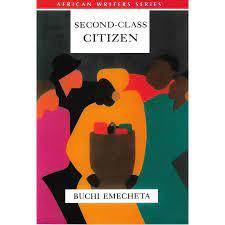
Second Class Citizen
The content of the novels on this website is provided as summaries to assist with revision. Candidates should ensure they read and fully understand all the relevant novels before the exams.
Second Class Citizen
Background, Plot, Settings, Themes, Characters
Background
Authorial Background
Florence Onyebuchi Emecheta was born on the 21st of July 1944. She is the daughter of a railway worker and a former enslaved woman. Her father died when she was eight years old. She won a scholarship to Methodist Girls’ High School in Lagos two years after this. At the age of 16, she graduated and married a student named Sylvester Onwordi. They had a daughter in 1960 and a son in 1961. Onwordi moved to London to continue his education and Emecheta and their children joined him in 1962. Between 1962 and 1966, she had three more children.
Onwordi, an abusive husband, burned the manuscript of the first novel Emecheta wrote. While pregnant with their fifth child, Emecheta left him. From 1965-69, she supported her five children by working as a library officer in London’s British Museum. Later on, she became a sociology student at the University of London where she began writing columns for a British newspaper. In 1972, she earned a Bachelor’s degree in sociology and published her first novel. In 1974, she published Second Class Citizen, a novel that is loosely based on her childhood in Nigeria and her abusive marriage. She has written several books and plays all throughout her career. After suffering a major stroke in 2010, she died in London in 2017.
Textual Background
Buchi Emecheta’s Second-Class Citizen is set against mid-20th century West Africa and Britain. In post-independence Nigeria, traditional norms and cultures, particularly patriarchal values that dictated gender roles in the family, were still deeply ingrained. At the same time, Britain and much of European society were grappling with immigration and the integration of non-European individuals, particularly Black people. This era was marked by systemic racial discrimination and inequality, especially for the Black population.
Emecheta draws from her own experiences to craft this deeply realistic story. She highlights the social and economic realities of the time to create a narrative that genuinely reflects both Nigerian and British societies from the 1940s to the late 1960s. Her aim is to illustrate the marginalisation of women in traditional African society and the status of Black individuals as "second-class citizens" in European society.
In the novel, Adah, the protagonist, embodies the struggles of a woman defying the limitations placed by traditional West African society. In the traditional Igbo society, the society dedicated that women were subservient to men and this led most women to be excluded from opportunities for personal and professional growth. Women were often married off once they managed to have primary education. At that time, girls who went on to have secondary education had educated parents or were lucky to relate with the church missions, particularly those run by nuns or had a scholarship grant.
In traditional Igbo society, when the head of the household died, the remaining family members were often redistributed among relatives. This reality is reflected in the novel when Adah’s father dies. Her mother is forced to marry her paternal uncle while Adah is sent to live with her maternal uncle and work as a servant. While living there, there is a discussion about marrying her off so that her bride price can be used to fund her younger brother’s education. She narrowly escapes this fate when her relatives are informed that she could fetch a higher bride price if she pursues further education.
When Adah marries Francis, she continues to battle the patriarchal system. Her husband, Francis, feels entitled to control her life and finances as the head of the household. The salary she earns from the library where she works is used to fund his sister’s education and his aspirations to continue his education abroad. This, again, reflects the traditional society’s devaluation of women’s dreams and contributions.
The title “Second Class Citizen” does not only refer to the marginalisation of women in traditional African society but also to the treatment of blacks in 20th-century European society. It refers to the systemic racism faced by African immigrants in Britain during that time. Most African immigrants often resorted to menial jobs, regardless of their qualifications. Mr Noble was a chief symbol of this. The racial prejudice is glaring in Adah’s search for housing, where landlords blatantly display signs such as “Sorry, No Coloureds” to deter blacks from applying for vacancies. Adah endures microaggressions and even overt racism while in Britain and this portrayal sheds light on the broader societal tensions of the era. Britain’s reluctance to embrace its immigrant population reflects the global struggle for racial equality during the civil rights movement and decolonisation.
Plot Account
Adah Ofili, an Igbo girl, was born Nigerian during the Second World War. Her father is a retired soldier while her mother is a housewife. Her family is so disappointed that she is not a boy that they forget to record her date of birth. While her younger brother, Boy, is allowed to go to school, she does not get to attend school. However, at the age of eight, she sneaks off to a nearby Methodist school where Mr Cole, their neighbour is a teacher. Back at home, the police get to know that a parent would deliberately refuse to encourage her child to go to school and have Ma arrested. Though, Adah’s Pa canes her for misbehaving – her parents decide to start sending her to school with Boy. Later, Ma, Pa and their friends celebrate the return of the first man from their hometown to get a degree in England. This inspires Adah, and she decides that she would like to travel to the UK someday.
Adah’s Pa dies suddenly and Ma remarries. Adah is sent to live as a domestic servant in her mother’s brother’s house. One day, when Adah is about 11 years old, her cousin gives her two shillings and sends her to get meat. The fee needed to take entrance exams for secondary school is exactly two shillings, so she chooses to use the money to pay for her entrance form and lies to her cousin that she has lost the money. Adah does so well in the entrance examination that she gets a full scholarship.
Adah prefers to get married after her secondary education. This is because she needs a home that she does not have, having lost her parents and having no kind-hearted extended family members to offer her a place of refuge or reprieve. She gets married to Francis at the age of 16. However, she finds neither love nor home in her marriage to Francis. Francis is a conservative Igbo man who believes in the Igbo culture of denigrating women.
Adah secures a well-paying job and earns three times more than her husband, Francis. This situation makes Francis feel insecure about his role. However, his father reassures him that whatever Adah earns is his to manage as the head of the household. Despite Adah’s significant contributions to the family’s expenses and her many responsibilities—acting as the breadwinner, mother, wife and caretaker—she does not receive any affection from Francis.
Adah convinces Francis that they should move to England for better opportunities. However, Francis’s father disapproves of women travelling to England and insists that Francis should go alone to study accounting with Adah supporting him financially from Nigeria. Although Adah is furious, she pretends to accept this plan. Once Francis departs for England, Adah begins working on persuading her in-laws to allow her to join him by arguing that she would be able to earn even more money if she moved to England.
Adah arrives in England with her two children, Titi and Vicky. She is horrified by the cramped room she finds that Francis rents. Despite Francis's attempts to persuade her to consider a factory job, Adah remains firm in her decision to seek only white-collar positions. Eventually, she lands a position as a library assistant, but not long after, she discovers that she is expecting their third child.
Francis and Adah agree that while she works, he will study and care for the children until a nursery spot opens up for them. However, after a while, Francis grows resentful of looking after the children and declares that he no longer wants to do it. To resolve the issue, Adah finds a certified “daily minder” named Trudy to care for the kids. Unfortunately, Vicky becomes very ill with viral meningitis due to Trudy's filthy apartment and inadequate supervision. Adah confronts Trudy about the situation and nearly becomes violent with her.
After Vicky returns from the hospital, both Francis and Adah receive an eviction letter from their landlord. Adah is not surprised; she believes her childless landlord is jealous of her for having children, and she feels that their neighbours resent her for having a white-collar job. For two weeks, every room advertisement she finds includes the phrase “Sorry, no coloureds.” They eventually come across one that does not discriminate against Blacks, but when they go to inspect the apartment, the white landlady lies and claims that the rooms have already been rented once she sees them. Desperate for a place to live, Adah decides to rent a run-down apartment from Mr. Noble, a Nigerian man who immigrated to England in the 1940s.
A week before her due date, Adah experiences painful movements in her womb. When she tells Francis, he accuses her of faking the pain to avoid work. Concerned for her well-being, she walks to the nearest clinic, where the doctor advises her to go to the hospital immediately. However, Adah is determined to have a home birth to save money and refuses to go. The doctor then contacts the midwives, who discover that she is bleeding heavily. Ultimately, Adah has an emergency C-section and gives birth to her son, Bubu. While recovering in the maternity ward, Adah observes how other women are treated by their husbands and comes to the painful realisation that she is in a loveless marriage with Francis.
Adah does not want to become pregnant again. She sneaks into a family planning clinic, despite her husband's disapproval of contraception, to obtain a cervical cap. Later that night, she ends up confessing about the cap after which he beats her so badly that Mr Noble intervenes. The following week, Adah discovers that she is pregnant again. She visits her family doctor and requests to terminate the pregnancy. He provides her with abortion pills. In the meantime, Adah starts a new job at a library, where she makes friends with her co-workers, including Bill, who introduces her to novels by Black writers.
After three months, Adah realises that the abortion pills she was given were fake and have not worked. Seeking a moment to gather her thoughts, she visits a park where she encounters Mr. Okpara, another Igbo immigrant who notices her distress. Concerned for her well-being, he listens as Adah shares her struggles. He offers to help her seek forgiveness from her husband, which she finds irritating but agrees to let him accompany her back to her apartment. Okpara takes the opportunity to confront Francis, warning him that Adah's unhappiness could lead to a mental breakdown, a fate that many lonely Nigerian immigrants face. He emphasises that Francis must find a job to earn the respect of their sons. Unfortunately, Okpara's words fall on deaf ears, and Francis remains unmotivated to change.
Eventually, Adah reveals to Francis that she is pregnant again and declares that she will no longer support him. Despite his protests, Adah stands her ground. After giving birth to their fourth child, a daughter named Dada, Francis finally secures a job. While he works, Adah dedicates herself to caring for their children and uses her spare time to write a novel titled “The Bride Price.” When she shares it with her coworkers, including Bill, he encourages her to pursue publication, calling it her "brainchild."
Excited by this new venture, Adah asks Francis to read her manuscript. However, he dismisses it as worthless, stating that no one would be interested in a black woman’s writing. Later, when Adah returns from grocery shopping, she is devastated to find Francis burning her manuscript. Feeling as though he has murdered one of her children, she resolves to leave him for good.
Adah secures a new job and relocates with the children. Eventually, Francis tracks Titi and Vicky to Adah’s new home and confronts her, saying that married Nigerians do not separate. Adah counters by pointing out that he violated Nigerian customs first by failing to provide for his family. He attacks her, beating and choking her until her neighbours upstairs intervene.
Adah decides to take Francis to court. Francis refuses to pay child support but Adah resolves to support the children by herself and leaves the courtroom.
Settings
Physical: Lagos, Nigeria and London, England.
Temporal: Mid-20th Century; 1940s - 60s.
Psychological: Hope and self-determination to disillusionment and struggle.
The novel begins in Lagos, where Adah, the protagonist, grows up. Lagos is depicted as a rapidly developing city where traditional norms still hold sway. Adah’s family live on Akinwunmi Street. Igbo and Yoruba families lived together and exchanged ethnic slurs about each other. Adah’s early life is shaped by the Igbo society’s patriarchal structure. They had a preference for male education whereas the girls can be educated to the point where they can count and write their names and then they are married off to fetch a bride price for the family.
The novel transitions to London, where Adah moves to join her husband, Francis. London represents a place of hope and opportunity for her, but it quickly becomes a harsh and disillusioning environment. Adah receives a cold welcome both from the English population and her fellow Nigerians. Their first landlord, landlady and tenants are not friendly simply because they are jealous of Adah’s ability to give birth to and keep her children with them, They are eventually evicted. Searching for a new apartment is also a chore for the couple as all vacant places have the sign: “Sorry, No Coloureds” to deter blacks from applying. Eventually, they settle for a run-down apartment on Willes Road owned by another Nigerian immigrant, Mr. Noble. Willes Road is a narrow, gloomy and uninviting place where Adah continues to experience her marital travails.
The novel portrays Adah’s emotional journey through the settings. Lagos, though oppressive, holds the promise of education and self-determination. London, while initially seen as a land of opportunity, becomes a place of disillusionment and struggle. Her unhappiness is heightened by her husband’s indifference and her own isolation in an unwelcoming society.
Themes
Marriage without Love
In Second Class Citizen by Buchi Emecheta, the theme of marriage without love is deeply explored. The novel portrays the struggles and sacrifices of Adah in a union devoid of affection, respect or mutual understanding. From the onset, Adah’s marriage to Francis is depicted as a product of societal and cultural expectations rather than personal choice or love. Adah, a determined and ambitious woman, marries Francis, hoping for support in her quest for a better life. However, it soon becomes evident that Francis does not share her aspirations or respect her individuality. His apathy towards her dreams and accomplishments highlights the lack of emotional connection in their relationship.
Francis’s domineering and abusive nature further underscores the lovelessness of their marriage. He consistently undermines Adah’s achievements, as seen when he burns her manuscript out of jealousy and disdain. Instead of being a partner who uplifts her, Francis becomes an obstacle to her growth. He shows no regard for her feelings or ambitions. His behaviour reveals a patriarchal mindset that reduces marriage to a transactional relationship, where the wife is expected to submit entirely to the husband’s will.
Additionally, Francis’s neglect of his responsibilities as a husband and father reinforces the absence of love in their marriage. He fails to provide financial or emotional support for Adah and their children, leaving her to shoulder the burdens alone. Despite his inadequacies, Francis expects Adah to conform to traditional gender roles and ignores her efforts to keep the family afloat by working. The irony is that despite his continuous insistence on conforming to gender roles as the Igbo tradition dictates, he fails to provide for and support his family. Rather, it is Adah who takes the role of the breadwinner in the family. His suggestion to put their children up for adoption during their court case exemplifies his detachment and lack of affection, not just for Adah, but for their family as a whole.
Adah’s persistence in the face of adversity highlights the emptiness of her marriage and her resolve to redefine her life outside its constraints. When Francis violently assaults her and destroys her belongings, Adah finally takes a stand and chooses to leave him despite societal pressures to remain in the marriage. Her decision to prioritise her safety and the well-being of her children over societal expectations reflects her realisation that a marriage without love is not worth enduring. This act of defiance marks her liberation from an oppressive union and her pursuit of self-fulfilment.
Ultimately, Emecheta uses Adah and Francis’s relationship to critique the societal and cultural norms that sustain loveless marriages. Through Adah’s journey, the novel emphasises the emotional and psychological toll of such unions on women and advocates for personal freedom and self-worth.
The Concept of “Second-Class Citizen”
The theme of the concept of second-class citizenship is central to Buchi Emecheta’s Second Class Citizen, as it explores how systemic inequality affects both women in Igbo patriarchal society and Black individuals in European settings. Through Adah, Francis, and Mr. Noble, the novel examines the marginalisation faced by women and Black people.
Adah’s experiences reflect the position of women as second-class citizens within Igbo society. Despite her intelligence and ambition, Adah faces constant resistance from societal norms that devalue women. From a young age, her dreams of education are discouraged, as resources are prioritised for her brother. In marriage, she is further subjugated by Francis, who dismisses her achievements and aspirations, insisting she conform to the role of a submissive wife. Francis’s refusal to read her manuscript and his destruction of her work underline the patriarchal belief that women’s voices and creativity are unimportant. This dehumanising treatment portrays women as secondary to men within Igbo culture.
Similarly, Francis’s character reflects the internalisation of his own second-class status as a Black man in a European society. His inability to find fulfilment or respect in his environment leads him to exert power over Adah, attempting to assert dominance within their marriage. His statement that Adah should “remember she is a woman and Black” encapsulates the dual layers of discrimination they face: gender-based oppression within their culture and racial prejudice in their host country. Instead of supporting Adah, Francis chooses to align himself with the oppressive norms he experiences and continue the cycle of subjugation.
The story of Mr Noble we have come to know in the novel is “when we became a second-rate person, when he became second-class” (p. 89). As it is said, he is a retired civil servant in Nigeria and the only son of a certain chief in Benin City. He came to England to study Law. But Poverty occasioned by his second-class graduation brings him down to his knees. He is a butt of jokes among his white friends, including some which demand that he undress to show that he has no tail. One day, he has an accident when his friends dare him to carry a lift with his hands. This is owing to the stereotype that Africans are extraordinarily strong. This leads to a permanent disability for him however, he gets compensation for an accident and buys a house. The stereotypical perception of Mr Noble highlights how blacks are often treated as subhuman.
Ultimately, Second Class Citizen portrays how intersecting oppressions based on gender, race and class render individuals powerless in both Igbo patriarchal society and European settings. Through the experiences of Adah, Francis and Mr. Noble, Emecheta critiques these systems of inequality while advocating for resilience, self-determination and the rejection of societal hierarchies that perpetuate discrimination.
Resilience and Determination
The theme of resilience and determination is a cornerstone of Buchi Emecheta’s Second Class Citizen, primarily embodied in the character of Adah. Despite the numerous challenges she faces, ranging from societal constraints to personal hardships, Adah remains resolute in her quest for a better life. Her unyielding spirit serves as an inspiration, illustrating the power of perseverance in overcoming adversity.
From her early life, Adah demonstrates extraordinary determination to achieve her goals. Growing up in a patriarchal Igbo society that prioritises boys’ education over girls’, she defies expectations by insisting on attending school. Her determination pays off as she becomes one of the few educated women in her community, securing a job as a librarian. This achievement, though modest by broader standards, is monumental in the context of her restrictive upbringing. It showcases her ability to rise above societal limitations.
Adah’s resilience is further tested in her marriage to Francis, which is fraught with emotional and physical abuse. Francis attempts to suppress her ambitions, but Adah refuses to abandon her dreams of self-improvement. Even when he burns her manuscript, destroying months of work, she channels her frustration into rebuilding her life. Her decision to leave Francis, despite cultural norms that discourage women from divorcing their husbands highlights her courage and resolve to live on her own terms.
In addition to battling gender-based oppression, Adah confronts racial discrimination in her life as a Black immigrant in the UK. She endures humiliation in her search for a new apartment. In most of the vacant apartments, the sign always read “Sorry, no Coloureds”. Her ability to navigate these intersecting oppressions highlights her strength and determination to create a better future for herself and her family.
Ultimately, Adah’s story is one of triumph against overwhelming odds. Her resilience and determination enable her to break free from the constraints of both Igbo patriarchy and the racial prejudice she encounters in Britain. By charting her own path, she not only reclaims her agency but also challenges the systems that seek to subjugate her. Through Adah’s journey, Second Class Citizen celebrates the indomitable spirit of women who refuse to be defined by their circumstances, offering a powerful message of hope and empowerment.
Characters
Adah
Adah, at the beginning of the novel, is an Ibuza girl. She is born in Nigeria during World War II. She is the daughter of Ma and Pa, a railway moulder. She is characterised by her curiosity and determination. From an early age, she challenges social norms and familial expectations. Despite her parents' decision to send only her younger brother, Boy, to school, she chose to turn things around by going to school. Although this lands her in trouble, her father eventually decides to send her to school.
After her father’s death, Adah begins dreaming of England, seeing it as a land of opportunity. By the age of 16, after completing her education, she married Francis Obi to facilitate her ambition of attending university in Lagos as societal norms would not permit her to live independently.
Adah’s life takes a significant turn when she becomes pregnant with her first child, Titi, and persuades Francis to relocate to England. Francis goes ahead of the family, and Adah soon gives birth to their second child, Vicky. Upon joining Francis in England, Adah encounters the harsh realities of racist housing policies and job discrimination. Despite these obstacles, she secures a job at a library and continues to provide for her growing family. After the difficult birth of her third child, Bubu, Adah decides to use contraception, secretly obtaining a cervical cap when Francis opposes her decision. When Francis discovers this, he beats her, but Adah’s resolve to leave him is interrupted by the discovery of another pregnancy.
Adah’s resilience shines through as she gives birth to her fourth child, Dada, and decides to prioritise her own fulfilment. During a brief period at home caring for her children, she writes the manuscript for a novel, The Bride Price, which brings her a deep sense of accomplishment. However, Francis’s insecurity and controlling nature culminate in him burning the manuscript, prompting Adah to finally leave him. Even after Francis tracks her down, assaults her, and destroys her possessions, Adah’s resolve remains unshaken.
Adah ultimately takes Francis to court, securing custody of her children and deciding to raise them on her own. Her journey is one of resilience and determination, as she navigates the challenges of patriarchy, racism, and domestic abuse while carving out a path for herself and her family. Through her struggles and triumphs, Adah exemplifies strength and self-reliance, refusing to let circumstances define her destiny.
Francis
Francis Obi, an accounting student, marries Adah while they are both minors in Nigeria. His parents, who are poor, support the marriage with the expectation that Adah’s education will ensure she becomes a good earner for the family. As a child, Francis witnessed his father beating his mother and would intervene to stop the abuse as he grew older, yet these experiences fail to foster respect for women in him. Instead, he views Adah as his possession, treating her achievements as tools for his own benefit. Initially threatened by Adah’s higher income, Francis quickly adjusts, deciding to take control of her salary and use it for his personal interests without regard for her opinions or needs.
When Adah proposes they move to London, Francis agrees. However, in London, he becomes demoralised by the pervasive racism and internalises a sense of inferiority, seeing himself as a “second-class citizen.” His inability to pass his accountancy exams, the original justification for their relocation, deepens his insecurities and fosters resentment toward Adah’s resilience and success. This bitterness drives him to exert control over her, escalating to physical abuse and forbidding her from using contraception, even after her health is jeopardised during the emergency C-section delivery of their third child.
Francis’s spiteful behaviour peaks when Adah writes the manuscript of a novel titled The Bride Price. Instead of supporting her creative aspirations, Francis burns the manuscript in an attempt to undermine her confidence and accomplishments. This cruel act becomes the catalyst for Adah to finally leave him. However, Francis’s controlling nature persists even after their separation. He tracks her down, asserting that Nigerian spouses do not separate, and subjects her to another violent assault.
When Adah takes Francis to court, he claims they were never married and refuses to contribute to the support of their children. His actions reveal his unrepentant nature and underscore his exploitative, misogynistic character. Francis’s behaviour throughout their relationship reflects a toxic combination of cultural conditioning, personal insecurity, and a deep-seated need to dominate and diminish others, particularly Adah, whose strength and determination highlight his inadequacies.
Trudy
Trudy is a plump, brash white woman who dyes her hair black and accentuates her look with bright red lipstick. As a registered childminder in Adah’s first London neighbourhood, she becomes Adah’s reluctant choice for childcare when nursery spots are unavailable for Titi and Vicky. Initially trusting Trudy, Adah grows suspicious when Titi suddenly stops speaking. A surprise visit to Trudy’s home reveals her daughters playing with Titi and Vicky’s toys, Trudy entertaining a possible sex-work client, and the children abandoned in a filthy, garbage-strewn backyard.
Alarmed, Adah reports Trudy to Miss Stirling, the local child officer. However, Trudy lies convincingly about the situation, shocking Adah, who realises for the first time that white people, like Black people, can be dishonest. This revelation challenges Adah’s initial assumptions about racial superiority. Despite her outrage, Adah continues to leave her children with Trudy, as Trudy promises to improve and there were no other childcare alternatives unavailable.
The situation escalates when Vicky contracts viral meningitis, and Adah immediately blamwa this on the unhygienic conditions at Trudy’s. Furious, she prepares to confront Trudy, accusing Francis of having an affair with her and threatening to kill them both if Vicky dies. When Adah finally confronts Trudy, the latter defensively blames Vicky’s illness on his supposed exposure to disease in Nigeria. Enraged by the blatant deflection, Adah attempts to strike Trudy and threatens her life.
Later that day, Miss Stirling inspects Trudy’s home and is appalled by the squalor. She swiftly assigns nursery spots for Titi and Vicky. Trudy loses her child-minding license and, perhaps fearful of Adah’s threats, relocates to a different neighbourhood.
Adah’s Ma
Adah’s Ma is a seamstress from Ibuza who has relocated to Lagos. As a child, Adah views her mother as the main barrier to her education. When Adah sneaks off to school against her mother’s wishes, Ma is briefly arrested for child neglect. However, a policeman who learns the full story remarks that Adah’s parents should send her to school, as she clearly has a strong desire to learn. In response, Ma looks at Adah with a mix of “fear, love, and wonder,” revealing that, while she may not fully grasp Adah’s ambitions, she does care for and admire her daughter in her own way.
After Pa’s death, Ma moves in with his brother and later remarries, which infuriates Adah. Around the age of 11, Adah begins to rebel against Ma’s efforts to betroth her to wealthy older men who can afford a high bride price. Adah manages to drive these suitors away and earns a scholarship to a boarding school, defying her mother’s expectations. This marks the beginning of Adah asserting her independence, despite her mother’s traditional views.
When Adah marries Francis, a poor student, as a teenager, Ma refuses to attend the wedding. Her anger stems from the fact that Francis cannot pay the bride price the family had demanded. This lack of familial support adds strain to Adah’s already complex relationship with her mother, further isolating her as she embarks on married life.
Shortly after Adah’s marriage, Ma dies at the young age of 38. Her death leaves unresolved tension between mother and daughter, as Adah never has the chance to reconcile their differences. This difficult relationship shapes Adah’s adult life, making it challenging for her to form close female friendships or trust other women.
Ma’s influence on Adah is both a source of conflict and an underlying motivation for Adah’s determination to succeed. While Ma’s traditional values clash with Adah’s aspirations, her complicated mix of love and disapproval leaves a lasting imprint on Adah’s journey toward independence and self-fulfillment.
Titi
Titi, Adah and Francis’s first child, is born shortly after their marriage. As a girl, Titi’s birth initially brings disappointment to Adah’s in-laws, who only begin to accept Adah after the birth of her second child, Vicky, a boy. When Adah relocates to England with Titi and Vicky, she notices that Titi suddenly stops speaking, which deeply worries her. Adah later discovers that Francis has threatened to beat Titi with a belt unless she speaks English. Since Titi’s English proficiency is still limited, she chooses silence over risking punishment.
This incident highlights the struggles of immigration for children, particularly the pressure to adapt to a new language and culture. It also underscores Francis’s harsh and violent approach to parenting, as well as his lack of understanding or patience with the challenges his family faces. Titi’s silence becomes a poignant symbol of both the difficulties immigrant children endure and the toxic environment created by Francis’s behaviour.
Vicky
Vicky, Adah and Francis’s second child and only son, is affectionately called Vicky by Adah, who never uses his full name, Victor. Adah gives birth to Vicky s
Shortly after Francis departs for England. Upon joining Francis in London, Adah struggles to find reliable childcare and reluctantly hires a white woman named Trudy to look after Titi and Vicky while she works. Trudy proves to be a neglectful babysitter, allowing the children to wander unsupervised in her dirty, garbage-strewn backyard.
When Vicky contracts viral meningitis, Adah blames Trudy for her negligence and also suspects that Francis, who she believes is having an affair with Trudy, shares responsibility. Overwhelmed by fear and anger, Adah vows to kill both Trudy and Francis if Vicky succumbs to his illness.
Adah’s Pa
Adah’s Pa is a reserved and dependable man whom she deeply loves and admires. As a child, Adah believes that her mother is the primary obstacle to her education, convinced that Pa would agree to send her to school if not for Ma’s influence. When her parents finally decide to allow her to attend school, Pa insists that Adah go to the same prestigious preparatory school as her younger brother, Boy, rather than settling for a less expensive option.
Tragically, Pa passes away unexpectedly when Adah is about eight years old, shortly after she starts school. His death leaves a profound impact on Adah, who mourns him throughout her life and cherishes his memory as a symbol of quiet strength and fairness. Pa’s decision to support Adah’s education, despite societal norms, reinforces her belief in her own potential and fuels her determination to succeed.
Pa’s influence extends beyond Adah’s education; his example shapes her understanding of what a man can be. His reliability and fairness set a standard that contrasts with the other men in Adah’s life, including her husband, Francis. As a result, Adah finds it easier to form and trust friendships with men, as she associates them with the qualities Pa embodies.
Even after his death, Pa’s legacy remains a source of inspiration for Adah. She often reflects on his support and kindness, which serve as a reminder of what she deserves in her relationships and the respect she should demand for herself. Pa’s quiet encouragement continues to guide her as she navigates the challenges of her life.
Through her enduring love and respect for Pa, Adah’s character is deeply influenced by his belief in her capabilities and his unwavering support, which remain a cornerstone of her strength and resilience.
Boy
Boy Ofili, Adah’s younger brother, plays a significant role in shaping her determination and resilience. When their parents prioritize Boy’s education by sending him to a prestigious prep school while keeping Adah at home, the disparity becomes a driving force behind Adah’s decision to sneak off to school. This act of defiance ultimately compels their parents to invest in her education as well, marking the beginning of Adah’s journey toward self-empowerment.
Although none of Adah’s family members attend her wedding to Francis, Boy demonstrates a sense of care and solidarity when he comes to the wharf to bid her farewell as she embarks on her journey to England. This small but meaningful gesture underscores the sibling bond they share, despite their family’s traditional attitudes and the societal pressures of the time.
Later, when Francis writes to his parents, complaining that Adah has obtained a contraceptive device without his consent, Boy’s true opinion of Francis emerges. Having always regarded Francis as a "good-looking good-for-nothing," Boy steps in to support his sister. He sends Adah his savings, urging her to return to Nigeria, and implicitly showing his disapproval of Francis’s behaviour. Boy’s actions highlight his protective instincts and his recognition of Adah’s struggles, even from afar.
Through his support, Boy Ofili serves as a reminder to Adah of her worth and capabilities, reinforcing her resolve to stand up for herself and chart her own course despite the challenges she faces.
Bill
Bill, a tall and handsome Canadian man, plays a pivotal role in nurturing Adah’s literary aspirations during her second library job. He engages her in discussions about literature and introduces her to influential Black writers like James Baldwin. When Adah shares the manuscript of her novel, The Bride Price, Bill recognizes its potential and encourages her to pursue publication, fuelling her dream of becoming an author.
Bill’s support goes beyond professional admiration—he validates Adah’s deep emotional connection to her work. When Adah confesses that completing the novel felt as fulfilling as giving birth, Bill affirms this comparison by calling the manuscript her “brainchild.”
This perspective profoundly influences Adah’s decision to leave Francis after he burns her manuscript. By destroying her “brainchild,” Francis symbolically kills a part of Adah. With this, Adah realises that his controlling and destructive nature poses a danger not only to her dreams but also to her actual children.
Okpara
Okpara, an Igbo Nigerian immigrant in England, encounters Adah in a public park when she is grappling with the failure of the abortion pills to terminate her fourth pregnancy. Misinterpreting her distress as a marital dispute, Okpara offers to help her seek forgiveness. Although Adah finds his assumption—that she is the one in need of forgiveness—irritating, she invites him to her apartment. There, Okpara confronts Francis and delivers a pointed lecture on the responsibilities of a man to support his wife and children, warning that failing to do so will cost Francis the respect of his sons.
Okpara serves as a foil to Francis. Unlike Francis, he successfully achieves his educational goals in London while remaining rooted in traditional Igbo values, particularly the expectation that a man should provide for his family. In contrast, Francis not only fails to accomplish the ambitions that brought him to London but also falls short of the cultural standards of manhood he was raised to uphold. Through this contrast, Okpara highlights Francis’s inadequacies both as a husband and as a father.
Mr Noble
Mr. Noble is Adah and Francis’s second landlord in London, a Nigerian immigrant who arrived in England in the 1940s, before Nigerian independence. Despite his early educational aspirations, he never achieved his academic goals and suffered an injury while attempting a reckless stunt as an elevator repairman. He used the compensation from this accident to purchase a three-story house, though his poor reputation among potential tenants complicates his ability to attract Nigerian renters. This is partly due to a bizarre rumour he propagated, claiming that his deceased mother, a witch, had killed the original tenants of the house. Mr. Noble is married to Sue, a much younger white woman, which further highlights his complex position as both an immigrant and a figure caught between cultures.