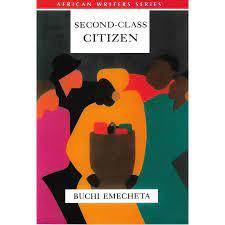
Second Class Citizen
The content of the novels on this website is provided as summaries to assist with revision. Candidates should ensure they read and fully understand all the relevant novels before the exams.
Second Class Citizen
Ditch Pull
-
Dada’s coming in May (Spring) has been marked by the continuous shining of the sun. Adah, for the first time, enjoys her five-month rest during which she does nothing but look after her four children who are under the age of five and compose the manuscript of The Bride Price.
-
Adah wishes to be a wife and mother, but no more. Francis starts arriving late to his own job because he is not happy about how satisfied his wife is with the new arrangement.
-
Adah continues to write her manuscripts. She writes by hand in “four school exercise books.” While writing, she forgets everything but her children.
-
Adah shows the completed manuscript to her former coworkers at the library. Bill recommends that she type up the manuscript and send it to a publisher. Finishing the manuscript made her feel as “fulfilled” as she had had another child, and she mentions that to Bill, he told her the novel was her own “brainchild.”
-
Adah asks Francis to read the manuscript but he says he would rather watch TV. He says to her: “You keep forgetting you are a woman and you are black” He describes black women as “brainless females” who would merely “think of nothing except how to breastfeed her baby” (p. 184).
-
Francis refuses to read Adah’s manuscript which he now calls rubbish, so she puts her manuscript with her library books and plans to buy a typewriter.
-
The next Saturday, Adah returns from grocery shopping to find Francis burning paper over the stove. She asks him why he cannot throw all those papers into the dustbin, instead of having them burned. He replied: “I was afraid you’d dig them out of the bin. So I had to burn them.” (p. 186)
-
Adah sees the cover of one of her school exercise books and realises that Francis has burned her manuscript. Adah, frustrated, tells Francis that Bill had called the novel her “brainchild” and asks how he could murder her child. She asks him: Do you hate me so much that you could kill my child?”
-
Francis replies: “I don’t care if it is your child or not. I have read it and my family would never be happy if a wife of mine was permitted to write a book like that” (p. 187).
-
She gets a job at the British Museum, finds a new, dirty two-room apartment, and moves out. As she attempts to leave, Francis breaks her fingers and bruises her mouth. He stops her from taking anything useful except her four children
-
A month later, Adah discovers that she is pregnant again. Francis follows Titi and Vicky home from school and bashes at her apartment window, trying to get in. Afraid that he would alert the Yoruba landlord whom she had told that her husband was back in Nigeria, she lets Francis in.
-
Francis announces that Nigerians don’t get divorced: his father beat his mother until Francis got old enough to intervene, but they never divorced.
-
Adah points out that Francis violated Nigerian norms first by failing to support his wife and children. She also accuses Francis of never reciprocating his mother’s love, since he never sent her money back from the UK.
-
In response, Francis violently assaults her. Only, Devlin the Irish man who lives on the top floor saves Adah and her children. Francis had come for the fight with a knife and was almost strangulating Adah when Devlin breaks down the door.
-
Rather than kill her, Francis begins to break a few properties that she had bought including the new radiogram that she had purchased since she left him about four weeks ago.
-
Their case goes to court. Francis claims that Adah's bruises and cuts are due to a fall. The magistrate awards Adah custody of the children and asks how much child support Francis is willing to pay for the children.
-
Francis claims that he and Adah were never married. He tells Adah, in their Ibo language, that he burned their marriage certificate and her passport. The magistrate says Francis must pay for child support as Adah cannot raise the children alone.
-
Francis suggests that they put the children up for adoption. Adah immediately tells the magistrate that she’ll care for the children herself and “never let them down.”
-
Adah leaves the court and walks aimlessly, crying. While she stands in front of a butcher’s shop in Camden Town, a voice suddenly calls out to her “Nne nna”, just like her father used to call her.
-
She recognises the man who called out. He is a friend from high school. He pays for Adah's taxi back home.
Possible Questions
-
Why does Francis refuse to read Adah’s manuscript? a) He finds it too complex b) He says she is a black woman and shouldn’t write c) He has no interest in reading d) He claims it is poorly written
-
What injury does Francis inflict on Adah as she attempts to leave with her children? a) He breaks her fingers and bruises her mouth b) He pushes her down the stairs c) He slaps her and breaks her arm d) He cuts her with a knife
-
What is Francis’s suggestion regarding their children during the court case? a) He wants full custody of the children b) He suggests putting them up for adoption c) He agrees to pay child support d) He offers to send them to Nigeria
-
Who rescues Adah during Francis’s violent attack in her apartment? a) Bill, her former coworker b) The police c) Her Yoruba landlord d) Devlin, her Irish neighbour
ANSWER: 1. B 2. A 3. B 4. D
Theory Questions
-
Describe the cultural clash depicted in Francis’s views on divorce compared to Adah’s determination to leave him.