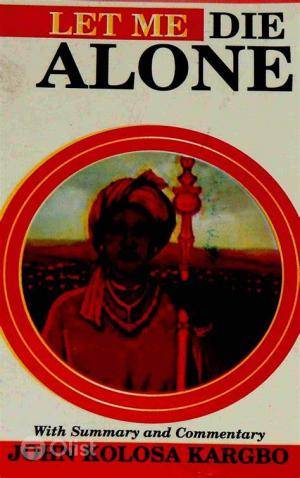
Let Me Die Alone
The content of the novels on this website is provided as summaries to assist with revision. Candidates should ensure they read and fully understand all the relevant novels before the exams.
Let Me Die Alone
Background, Plot Account, Settings, Themes
Background
Authour's Background
John Kolosa Kargbo was a Sierra Leonean playwright, poet, and teacher known for his contributions to African literature, particularly in drama. He was deeply invested in the history and cultural identity of Sierra Leone, and his works reflected themes of COLONIALISM, TRADITION, POWER STRUGGLES and RESISTANCE. Kargbo’s literary career was influenced by the political and social realities of post-colonial Sierra Leone, and he used theatre as a medium to explore historical events and their impact on African society. His play Poyo Togn Wahala, which demonstrated the corruption, incompetence and indifference of the ruling elite incurred the wrath of the ruling elite in government in Sierra Leone and he was forced to go into exile in Nigeria. Let Me Die Alone was written later on and it is one of his few plays that is written in English. Most of his plays were written in the local Krio and vernacular. His ability to blend history with creative storytelling made his works significant in African drama, and Let Me Die Alone is one of his most notable plays.
Textual Background
Let Me Die Alone (1976) is based on the historical marital life and times of Madam Yoko, a legendary monarch of the Mende people. It addresses the gender struggles of the famous Madam Yoko, who was the first notable female Paramount Chief over the Mende people in the Southern province of Sierra Leone. She ruled the Mende people from 1884-1906.
Let Me Die Alone (1976) examines colonial politics in Africa. Colonialism has come to define how Africa views and interprets her history. It began when a group of Europeans - English, French, Portuguese and Germans, among others extended their territories to Africa in the 19th century for economic benefits and other enlightenment purposes. In the play, the colonial authority is represented by GOVERNOR SAMUEL ROWE and his actions are representative of the British colonial actions in Africa. Such actions include:
- Utter disregard for existing customs and traditions
- Lack of respect towards the African peoples
- Arbitrary alteration of landmarks without consulting the people.
Another background issue in the play is female leadership in Africa. Precolonial and colonial Africa was a largely PATRIACHAL space, and while women had their dignity and place, it was more difficult or women to access power spaces because of entrenched patriarchal biases. This does not mean that precolonial and colonial Africa did not produce worthy female leaders, the problem was that it was more difficult for a woman to be considered for such important roles. The woman had to doubly prove herself and most of the time had to make more personal sacrifices compared to the men in order to be granted access to leadership positions. This is exactly what Mama Yoko has to go through in order to be the chief of the Mende Land.
Madam Yoko (ca. 1849-1906)
Madam Yoko, also known as Mammy Yoko, was born around 1849 in the Gbo Chiefdom and was a prominent leader of the Mende people in Sierra Leone. She rose to power through a combination of advantageous lineage, strategic marriage choices and the influence granted to her by the secret SANDE SOCIETY. Yoko significantly expanded the Mende kingdom, and by the time of her death, she ruled over the extensive Kpa Mende Confederacy. She changed her name to Yoko during her initiation ceremony into the Sande Society, where she became known for her graceful dancing.
Yoko's first marriage was to a man named Gongoima, but it was unsuccessful. After leaving Gongoima, her second husband was Gbenjei, the Chief of Taiama. Following Gbenjei’s death, Yoko married Gbanya Lango. In 1875, Gbanya was detained by the Colonial Officials in Taiamawaro. Yoko went directly to Governor Rowe to appeal for her husband’s release. Rowe was impressed with Yoko’s appeal and Gbanya was flogged, and then released. Following this incident, Gbanya made Yoko his great wife and began sending her on diplomatic missions.
With the support of the Sande society, Yoko wielded significant political power, not only among women but also within the Mende people as a whole. As a leader in this women’s secret society, she forged political alliances and took younger initiates as wards, later marrying them into aristocratic lineages. In 1878, after Gbanya's death, she became the Chief of Senehun. By 1884, she was officially recognized as the Queen of Senehun, a title granted by both her people and the British. She died in 1906, with rumors suggesting she may have committed suicide. After her passing, her brother Lamboi succeeded her, as she had no descendants of her own.
Plot Account
The play tells a story about GBANYA’s final days as chief of the Mende people. He faces threats from enemies within and outside his community. Without a son to take over his position, he considers making his first wife, MAMA YOKO, the leader. However, during wartime, he doubts that a woman should be in charge, which makes him uncertain about his choice. After being embarrassed by GOVERNOR SAMUEL ROWE for his role in the Caulker campaigns, and realizing too late that LAMBOI and MUSA plan to poison him and take his throne, Gbanya finally names Mama Yoko as his successor before he dies. Mama Yoko then faces many challenges from Lamboi, who tries to block her from becoming chief. To prove herself, she must join the Poro secret society and promise not to marry or have children.
Mama Yoko displays strong leadership by expanding the Mende Chiefdom and relocating the capital from Senehun to Moyamba. She takes initiative by leading attacks on neighboring villages instead of waiting for them to strike first. Mama Yoko is depicted as a fair leader who, at the peak of her influence, governed a prosperous and peaceful territory. However, she has to face many plots and intrigues from her enemies like KEKE LAMBOI and NGO MUSA, who kill Jeneba, Napi and Jilo’s daughter whom Mama Yoko loves , bury her after removing her vital parts, and then try to implicate Mama Yoko in the mysterious disappearance and murder of the child. The people turn against Mama Yoko and this breaks her heart in many irreparable ways. When the truth is finally revealed and Mama Yoko is justified, the Governor seals the monarch’s doom by reducing the size of her domain. At this point, Mama Yoko loses the will to live as she cannot stand the disgrace. Honour suicide seems the only way out.
Settings
Physical Setting: The play is set in MENDE LAND, in the Southern Province of Colonial SIERRA LEONE. The primary locations include:
- Gbanya’s palace (barre) – Located in SENEHUN (where Gbanya reigned from) and MOYAMBA (where Queen Yoko reigned from). This serves as the political centre of the Mende kingdom, where crucial decisions regarding leadership and colonial interactions are made.
- Gbanya’s bedroom
- Ndapi/ Jilo’s Hut
- the Poro bush
Temporal Setting: The play is set in the LATE 19TH CENTURY, a period marked by the expansion of British colonial rule in Sierra Leone. This was a time of significant political turmoil as indigenous rulers grappled with the growing influence of European powers. The play reflects historical events such as:
- The imposition of colonial taxes, which led to resistance from local chiefs.
- The struggle for leadership among African rulers, particularly within the Mende kingdom.
- The increasing interference of the British in African governance, as seen through Governor Rowe’s actions.
Psychological Setting: The psychological atmosphere of the play is one of tension, ambition, and betrayal. The characters experience deep emotional conflicts due to:
- Political instability – Gbanya fears losing his position, while Madam Yoko navigates both internal and external threats to her rule.
- Colonial oppression – The British presence creates anxiety and frustration among the indigenous rulers, who must decide whether to resist or collaborate.
- Personal ambitions and betrayals – Madam Yoko’s rise to power, Lavalié’s opposition to taxation, and the treachery of those around them create a sense of unease and mistrust.
Themes
Traditional Society vs. Western Civilisation:
The play contrasts indigenous traditions with the influence of Western civilization. Madam Yoko embodies a blend of both, as she adopts aspects of modernization while maintaining her cultural identity. The British colonialists attempt to impose their systems and governance on the people, dismissing local customs as primitive. This clash highlights the struggle between maintaining African heritage and embracing foreign influences.
Traditional and Unfair Demands on Womanhood:
Madam Yoko's rise to power comes at a personal cost—she remains childless and sacrifices conventional roles expected of women. The play reflects how traditional societies impose rigid expectations on women, limiting their choices to marriage and motherhood. Madam Yoko’s leadership challenges these norms, but she faces resistance from men and women alike, showing the societal difficulty of accepting female authority.
Battle of the Sexes:
There is a clear struggle for dominance between men and women in the play. While Madam Yoko proves to be a strong and competent leader, she faces continuous opposition from male figures like Lamboi and Musa, who conspire against her. This theme highlights the power struggle between genders and the patriarchal structures that seek to undermine female leadership.
The Importance of Traditional Dancing, Singing and Beliefs:
Throughout the play, traditional music, dance and rituals serve as expressions of cultural identity and resistance. These elements reinforce communal bonds and heritage, emphasizing that African societies had rich traditions before colonialism. The rituals also play a role in leadership transitions and decision-making processes.
Modern Feminist Concerns
Madam Yoko’s story resonates with modern feminist themes, such as women’s empowerment, leadership, and the fight against patriarchal oppression. Despite her intelligence and capability, she is undermined by men who refuse to recognize her authority. Her struggles reflect broader issues of gender discrimination and the challenges faced by women who defy societal norms.
Colonialist Arrogance
The British colonial officers in the play regard African customs with condescension, imposing their own governance structures and dismissing local authority. This theme highlights the exploitative nature of colonial rule, where indigenous leaders like Madam Yoko are used to maintain colonial control while being denied true power and respect.
Blackmail
Blackmail is a key strategy used by characters like Musa and Lamboi to manipulate situations to their advantage. They exploit secrets and personal weaknesses to achieve their goals, demonstrating how deception and coercion play a role in political and personal conflicts.
Betrayal
Betrayal is a central theme in Let Me Die Alone, particularly through the actions of Lamboi and Musa, who plot against Madam Yoko despite her leadership and contributions to society. The theme of betrayal extends beyond personal treachery to the broader political betrayal of traditional African leaders by colonial authorities.