This question is based on Literary Principles.
'At the most remote end of the crypt there appeared another less spacious. Its walls had been lined with human remains piled to the vault overhead. In the fashion of the great catacombs of Paris. Three sides of this interior crypt were still ornamented in this manner. From the fourth the bones had been thrown down , and lay promiscuously upon the earth, forming at one point a mound of some size',
E. Pope, 'Cask of Amontillado'
In the passage above, the author evokes the atmosphere of
cannibalism
monstrosity
evil
doom
Explanation
Video Explanation
No video available
Post your Contribution
Discussions (6)

The correct answer is D. doom.
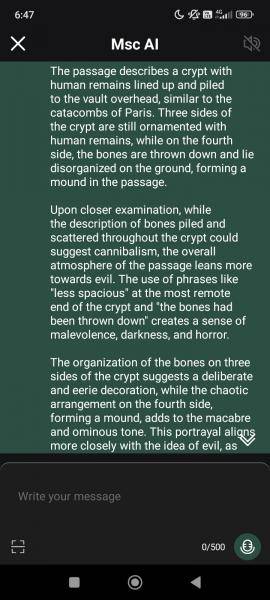
The passage describes a crypt with human remains piled up to the vault overhead, evoking a sense of mortality and death. The image of bones thrown down and lying promiscuously on the earth, forming a mound, adds to the somber and ominous atmosphere. The reference to the catacombs of Paris, a famous burial site, further reinforces the theme of death and mortality. The author, Edgar Allan Poe, was known for his mastery of creating atmospheric settings, and in this passage, he evokes a sense of doom, death, and mortality, making option D the best choice.
The other options do not accurately capture the atmosphere:
A. Cannibalism: There is no suggestion of cannibalism in the passage.
B. Monstrosity: While the scene is eerie and unsettling, it does not evoke a sense of monstrosity.
C. Evil: While the passage has a dark and ominous tone, it does not specifically evoke a sense of evil.
The correct answer is D. doom.
The passage describes a crypt with human remains piled up to the vault overhead, evoking a sense of mortality and death. The image of bones thrown down and lying promiscuously on the earth, forming a mound, adds to the somber and ominous atmosphere. The reference to the catacombs of Paris, a famous burial site, further reinforces the theme of death and mortality. The author, Edgar Allan Poe, was known for his mastery of creating atmospheric settings, and in this passage, he evokes a sense of doom, death, and mortality, making option D the best choice.
The other options do not accurately capture the atmosphere:
A. Cannibalism: There is no suggestion of cannibalism in the passage.
B. Monstrosity: While the scene is eerie and unsettling, it does not evoke a sense of monstrosity.
C. Evil: While the passage has a dark and ominous tone, it does not specifically evoke a sense of evil.

There is no suggestion of cannibalism if u rely solely on the passage,except u r using a prior knowledge of the book itself,in which case the question is no longer a test of literary appreciation.