Residual powers in the 1979 Constitution of Nigeria were vested in the
local and state governments
state government
federal government
local government
Explanation
Video Explanation
Post your Contribution
Discussions (20)


Residual power were vested in the local gov't while the state has a concurrent power

Local Government wasn't autonomous as of 1979 , therefore, the answer is State.

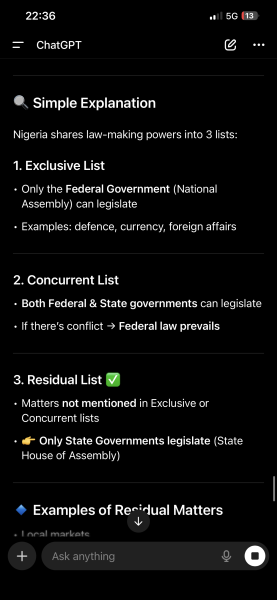
the answer is the state government. local cannot legislate, its only the state govt that can legislate for them
The 1979 constitution did not explicitly mention whose duty it was to perform reaidual functions or power
So given that there was a functioning local government then
i will say that the residual powers were left for both the atate and Local government
making
The answer A 
The answer to the question is
C. federal government
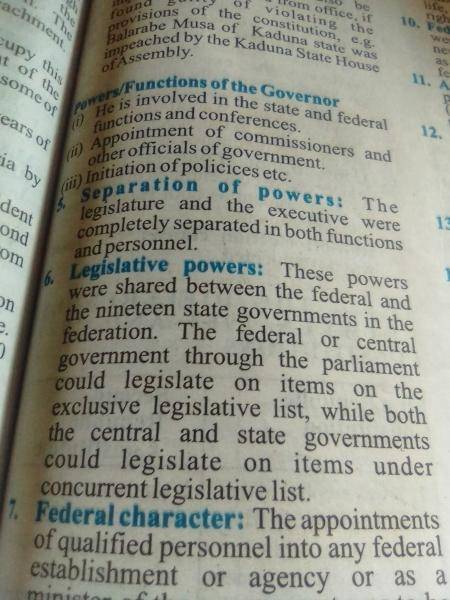
The 1979 constitution did not provide a residual powers for the local government, intead it provided only exclusive (federal) concurrent ( federal and state) and so any othe functions that are not in these two list were to reserved for the federal or central government, thereby maintaining national unity and uniformity in governance.

Correct answer is B
* Exclusive power is vested in central government which is the president .
* Residual power is veasted in central&state government ,but if any issue arise central government power supperside.
* concurrent power is vested in local government.

