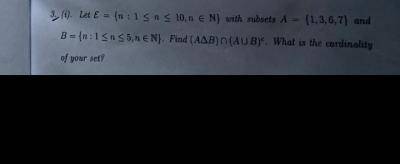
Let E={n:1≤ n ≤ 10,n is an element of set of natural numbers} with subjects A={1,3,6,7} and B={n:1≤ n ≤ 5,n is an element of set of natural numbers}. Find (A∆B)n(AuB)'. What is the cardinality of your set?
Emmanuel123ewa
20 Jun, 2023
To get notifications when anyone posts a new answer to this question
Answers (1)
Post your comment

In solving this problem, understand the context question.
*If the numbers contained in the Universal sets, houses natural numbers not less than one, and not greater than 10.
Universal set={natural numbers from 1-10}
Now, solve the question in bits.
First, find the symmetric difference (A∆B) and the union (AuB) of sets A and B.
A∆B = {1, 3, 6, 7} ∆ {1, 2, 3, 4, 5} = {2, 4, 5, 6, 7}
AuB = {1, 3, 6, 7} U {1, 2, 3, 4, 5} = {1, 2, 3, 4, 5, 6, 7}
Next, we need to find the complement of the union (AuB)'. This is the set of all elements that are not in the union.
(AuB)' = {8, 9, 10}
Finally, we need to find the intersection of the symmetric difference and the complement of the union.
(A∆B)n(AuB)' = ({2, 4, 5, 6, 7} n {8, 9, 10}) = {}
Therefore, the cardinality of this set is zero.
Quick Questions
chifresh
4 May, 2020