jamb note on wave motion?

www.precious.com
11 Apr, 2021
To get notifications when anyone posts a new answer to this question
Answers (2)
Post your comment

Wave motion is the transfer of energy and momentum from one point of the medium to another point of the medium without actual transport of matter between two points. Wave motion is classified into three different ways they are,
The medium of propagation,
The dimensions in which a wave propagates energy,
The energy transfer
Based on the Transfer of Energy
Standing waves (or stationary waves)
Progressive wave
Standing waves remain Confined to a region without any transfer of energy and momentum whereas the progressive waves transfer energy and momentum between the particles of the medium.
Mechanical waves (Elastic waves)
Waves that require a medium for their propagation are called mechanical waves or elastic waves. The particles of the medium execute periodic motion about a mean position when the wave propagates through the medium.
For Example, waves on a string
A mechanical wave is produced due to a disturbance at a point in a medium.
The disturbed particle interacts with the neighbouring particle and its energy is handed over to the next particle (due to the inertia of the medium).
The disturbed particles retune to the equilibrium position (due to the elasticity of medium).
Properties of Medium for Mechanical Wave Propagation
The medium must possess inertia so that its particles can store kinetic energy.
The medium must possess elasticity.
The minimum frictional force between the particles of the medium.
Non-Mechanical Waves
Waves which do not require a medium for their propagation are called a non-mechanical wave. These types of waves can propagate through vacuum also. These are transverse in nature. For example, electromagnetic waves and matter waves.
Transverse Wave Motion
The particles of the medium vibrate in a direction perpendicular to the direction of propagation of the wave. The region of maximum upward displacement is called the crest region of maximum downward displacement is called trough.
Transverse wave motion occurs only through a medium which has rigidity modulus or shape conservation. For example, string waves.
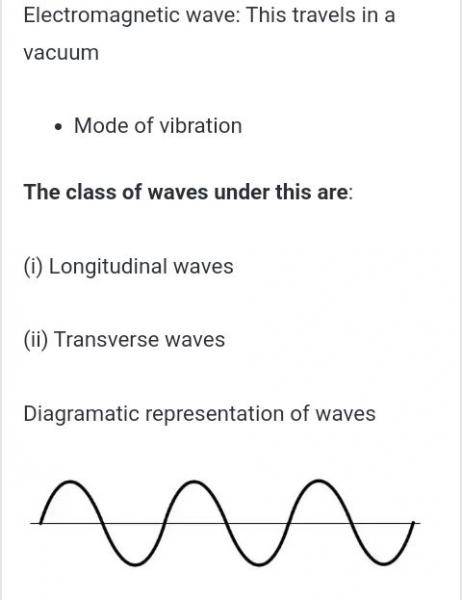
Transverse waves
Longitudinal Wave Motion
The particles of the medium vibrate about their equilibrium position in a direction parallel to the direction of propagation of the wave is called a longitudinal waves.
Longitudinal waves require a medium with only elasticity of volume (or Bulk modulus) for its propagation. In this type of wave motion, the waves travel through a medium in the form of compression and rarefaction.
Longitudinal wave Motion
The region of high pressure is called compression and the region of low pressure is called rarefaction. For example, Sound waves in the tube

Share:
Quick Questions
javy01
2 Jun, 2026
a compund microscope by lens of focal length 1cm and 5cm.an object placed 1.2cm from the objective lens if a virtual image is formed 25cm from the eye piece .the distance between the two lens is explain and solve with diagram?
JaynetIkeola
17 Jun, 2026