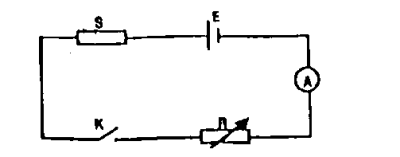
3a. (i) Measure and record the e.m.f of the accumulator provided.
(ii) Connect the circuit as shown in the diagram. S is a standard resistor, and R is a resistance box.
(iii) With R = 0 Ω, close the key K. Read and record the ammeter reading I. Evaluate I\(^{-1}\).
(iv) Repeat the procedure for R = 1, 2, 3, 4, and 5 Ω. Tabulate your readings.
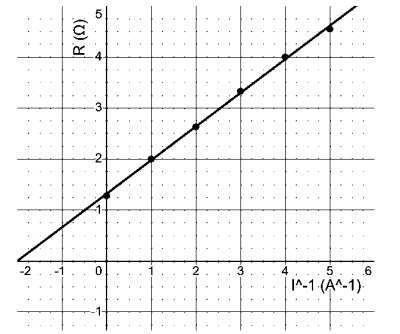
(v) Plot a graph of R on the vertical axis and I\(^{-1}\) on the horizontal axis, starting both axes from the origin (0,0).
(vi) Determine the slope s of the graph and find the intercept c on the vertical axis.
(vii) State two precautions taken to ensure accurate results. [21 marks]
bi. State two advantages of a lead-acid accumulator over a Leclanche cell. [2 marks]
ii. A parallel combination of 3 Ω and 4 Ω resistors is connected in series with a resistor of 4 Ω and a battery of negligible internal resistance. Calculate the effective resistance in the circuit. [2 marks]


3a. The e.m.f of the accumulator = 1.5V
Tables of values
| R(\(\Omega\)) | I(A) | I\(^{-1}\)((A\(^{-1}\)) |
| 0 | 0.78 | 1.28 |
| 1 | 0.50 | 2.00 |
| 2 | 0.38 | 2.63 |
| 3 | 0.30 | 3.33 |
| 4 | 0.25 | 4.00 |
| 5 | 0.22 | 4.55 |
S = \(\frac{y_2 - y_1}{x_2 - x_1}\) = \(\frac{4 - 2}{4 - 1}\) = \(\frac{2}{3}\) = 0.67
The intercept on the vertical axis = 1.32\(\Omega\)
Precautions:
(i) I ensured all electrical connections were securely tightened to prevent loose contacts, which could lead to fluctuating or inaccurate readings.
(ii) I avoided parallax error by positioning my eyes directly in line with the scale when reading the ammeter or voltmeter for precise measurements.
(iii) I checked and corrected for any zero error on the ammeter and voltmeter before taking readings to improve accuracy.
(iv) I removed the key from the circuit when not taking measurements to avoid unnecessary heating and potential damage to components.
(v) I took multiple readings at each data point and averaged the values to minimize random errors and ensure more reliable results.
(vi) I ensured the apparatus was properly calibrated and regularly checked for consistency throughout the experiment.
bi. 1. Rechargeability: A lead-acid accumulator is rechargeable, making it more suitable for long-term use, whereas a Leclanché cell is primarily a primary (non-rechargeable) cell.
2. Higher Current Supply: Lead-acid accumulators can deliver higher currents, making them ideal for applications requiring significant power, like in vehicles, while Leclanché cells are suitable for low-current devices.
3. Longer Lifespan: Due to its rechargeable nature, the lead-acid accumulator has a longer operational life compared to a Leclanché cell, which has a limited lifespan and must be replaced after depletion.
4. Stable Voltage: Lead-acid accumulators provide a relatively stable output voltage during discharge, while the voltage of a Leclanché cell drops significantly over time.
bii. Since 3 Ω and 4 Ω are connected in parallel,
\(\frac{1}{\text{R}}\) = \(\frac{1}{3}\) + \(\frac{1}{4}\)
\(\frac{1}{\text{R}}\) = \(\frac{4 + 3}{12}\)
\(\frac{1}{\text{R}}\) = \(\frac{7}{12}\)
R = \(\frac{12}{7}\) = 1.71 Ω
Now, 1.71 Ω is connected in series with 4 Ω.
∴ The effective resistance in the circuit = 1.71 Ω + 4 Ω = 5.71 Ω





Contributions ({{ comment_count }})
Please wait...
Modal title
Report
Block User
{{ feedback_modal_data.title }}