1a. (i) Using the spring balance provided, determine the weight of an object of mass M = 5.0 g. Record this weight as W\(_1\).
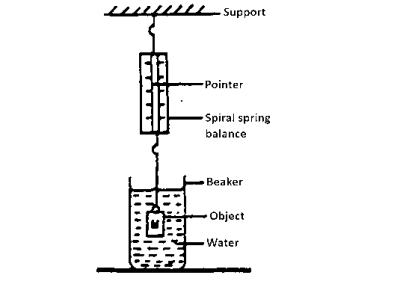
(ii) Determine the weight of the object when completely immersed in water contained in a beaker as shown in the diagram. Record the weight as W\(_2\).
(iii) Determine the weight of the object when it is completely immersed in the liquid labelled "L". Record the weight as W\(_3\). Evaluate u = (W\(_1\) - W\(_2\)) and v = (W\(_1\) - W\(_3\)).
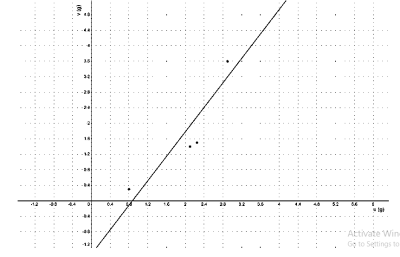
(iv) Repeat the procedure with the objects of masses M = 10, 15, 20, and 25 g. In each case, evaluate v = (W\(_1\) - W\(_3\)) on the vertical axis against u = (W\(_1\) - W\(_2\)) on the horizontal axis.
(v) Determine the slope, s, of the graph.
(vi) State two precautions taken to ensure accurate results.[21 marks]
bi. A piece of brass of mass 20.0 g is hung on a spring balance from a rigid support and completely immersed in kerosene of density 8.0 × 10\(^2\) kgm\(^{-3}\). Determine the reading on the spring balance. [g = 10 ms\(^{-2}\), density of brass = 8.0 × 10\(^3\) kgm\(^{-3}\)]
(Provide your answer with unit e.g 123.123 m)
bii. Archimedes' Principle and Law of Floatation [2 marks]
Explanation
Video Explanation
No video available
Post your Contribution
Discussions (0)
No comments yet
Be the first to comment

