4a. Define the boiling point of a liquid.
b. Describe with the aid of a labelled diagram, an experiment to determine the boiling point of a small quantity of a liquid.
c. State two factors that may affect the boiling point of a liquid.
d. Using the kinetic theory of matter, explain why pure water changes to steam at S.T.P without any change in temperature, although heat is being supplied to the water.


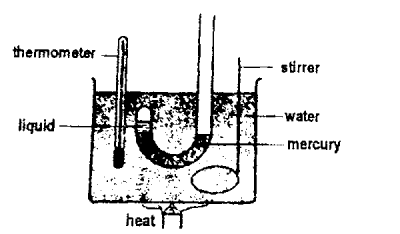
a. The boiling point of a liquid is the temperature at which a (pure) liquid changes from the liquid to the gaseous state without a change in temperature when the atmospheric pressure is normal (760 mmHg)
b. Aim: To determine the boiling point of a small quantity of a liquid
Apparatus: J-tube, thermometer, water, beaker & source of heat.
Procedure: The J-tube, as shown in the diagram, is heated in a beaker of water, and the water in the J-tube is monitored. It remains trapped until the water in the beaker is boiling. Then the water in the tube comes to the same level in each limb, showing that the pressure of the vapour in the closed limb is equal to the pressure of air outside. Conclusion: Equal levels in the two limb shows that the vapour pressure is equal to the atmospheric pressure, which is the boiling point of the liquid. The experiment is repeated, and the mean is taken.
c. (i). Presence of impurities (ii). Pressure on the liquid (iii) Nature of liquid.
d. According to the kinetic theory of matter, temperature depends on the average kinetic energy of the molecules. When pure water boils, the heat supplied is not used to increase the kinetic energy of the molecules. Instead, it is used to overcome the intermolecular forces holding the water molecules together in the liquid state.
This energy, called latent heat of vaporization, separates the molecules to form steam. Since the kinetic energy of the molecules does not increase, the temperature remains constant until all the water has changed to steam.





Contributions ({{ comment_count }})
Please wait...
Modal title
Report
Block User
{{ feedback_modal_data.title }}