1a. Explain what is meant by the acceleration of free fall due to gravity, g.
b. State two reasons why g varies on the surface of the Earth.
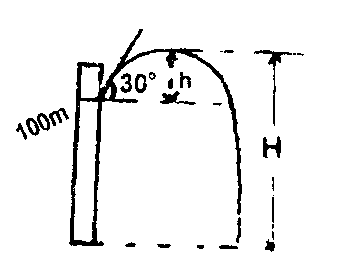
c. A stone is projected upwards at an angle of 30° to the horizontal from the top of a tower of height 100 m and it hits the ground at a point Q. If the initial velocity of projection is 100 ms\(^{-1}\), calculate the:
i. maximum height of the stone above the ground (neglect air resistance and take g as 10 ms\(^{-2}\))
ii. time it takes to reach this height
iii. time of flight.
iv. horizontal distance from the foot of the tower to the point Q (neglect air resistance and take g as 10 ms\(^{-2}\))


1a. Acceleration of a free fall due to gravity is the force of attraction of the Earth on a unit mass.
b. g varies on the surface of the earth because of the shape of the earth and the rotation of the earth about its polar axis.
ci. θ = 30°; H = 100 m; u = 100 m/s; h = ?
Total height = H + h
=> h = \(\frac{u^2 sin^2 θ }{2g}\) = \(\frac{100^2 sin^2 30°}{ 2 \times 10}\)
= \(\frac{10000 \times 0.25}{ 20}\) = \(\frac{2500}{ 20}\) = 125 m
. Height from the ground = height of tower + the maximum height the stone reached = 100 + 125 = 225 m
ii. t = \(\frac{u sin θ }{\text{g}}\) = \(\frac{100 \times sin 30°}{10}\) = \(\frac{100 \times 0.5 }{10}\) = 10 × 0.5 = 5 s
iii. Time of flight = time taken for a particle which is projected to return to its original level T = \(\frac{2u sin θ}{\text{g}}\) = \(\frac{2 \times 100 \times sin 30°}{10}\) = \(\frac{200 \times 0.5}{10}\) = 10 s
Time of flight = 10 s
But the total time taken to land on the ground = T + time used to return from the top of the tower to the ground level. Since it's falling S\(_y\) = 100 m
S\(_y\) = ut sin θ - \(\frac{1}{2}\) g t\(^2\) => -100
= 100t sin 30° - \(\frac{1}{2}\) (10) t\(^2\) =>
-100 = 100t × 0.5 - 5 t\(^2\) => -100 = 50t - 5 t\(^2\) => 5 t\(^2\) - 50t - 100 = 0 => t\(^2\) - 10t - 20 = 0
t = \(\frac{10 \pm \sqrt{10^2 - 4 \times -20 \times 1}}{2}\) = \(\frac{10 \pm \sqrt{100 + 80}}{2}\)
t = \(\frac{10 + 13.416}{2}\) = \(\frac{23.416}{2}\) ≈ 11.7s (ignore the -ve part)
t = 11.7 s => Total time = 10 + 11.7 = 21.7 seconds
iv. Horizontal distance = the range = \(\frac{u^2 sin 2θ}{\text{g}}\) = \(\frac{100^2 sin 60°}{10}\) = \(\frac{10000 \times 0.866}{10}\) = 1000 × 0.866 = 866 m





Contributions ({{ comment_count }})
Please wait...
Modal title
Report
Block User
{{ feedback_modal_data.title }}