(a) You are provided with two metre rules, two retort stands, a mass, m = 100g, thread, and other necessary apparatus
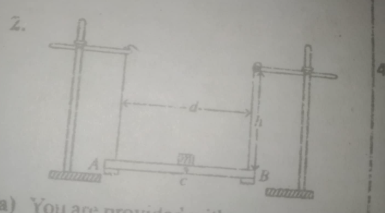
(i) Place one of the metre rules on a knife edge and determine the centre of gravity, C
(ii) Measure and record the mass, M\(_R\) of the metre rule
(iii) Attach the mass = 100g firmly to the metre rule AB at C using paper tape
(iv) Suspend the metre rule by two parallel threads of length, h = 40cm each at 10 cm and 90cm mark. Ensure that the graduated face of the metre rule is facing upwards.
(v) Set the metre rule into small angular oscillation about the vertical axis through the centre of gravity.
(vi) Determine the time, t for 20 complete oscillations. Evaluate the period T and T\(^2\).
(vii) Read and record the value of d in metres.
(viii) Keeping d, constant, repeat the procedure for four other values of h = 50, 60, 70, and 80 cm. In each case, determine t and evaluate T and T\(^2\).
(ix) Tabulate the readings
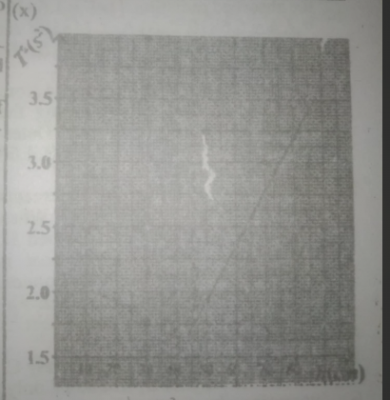
(x) Plot a graph of T\(^2\) on the vertical axis and h on the horizontal.
(xi) Determine the slope, s of the graph
(xii) Evaluate K = \(\frac{\text{S}}{\text{Q}}\) where Q = \(\frac{2}{25d^2}\)
(xiii) State two precautions taken to ensure accurate results
b(i) Define couple as it relates to oscillatory motion
(ii) Give two practical applications of a couple in everyday life.
Explanation
Video Explanation
No video available
Post your Contribution
Discussions (0)
No comments yet
Be the first to comment

