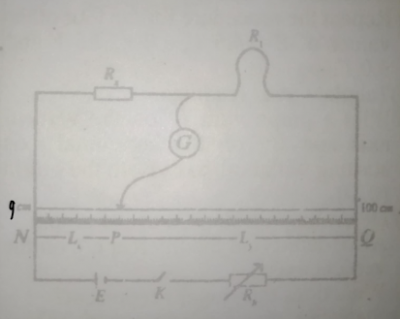
(a) You are provided with two resistance wires labelled: A and B, standard resistor, R\(_x\) = 1 \(\Omega\), metre bridge, cell of emf,E, Rheostat R\(_h\), galvanometer and apparatus as shown.
Use the circuit diagram above as a guide to perform the experiment.
(i) Connect R\(_x\) in the left-hand gap of the metre bridge, a length L = 100 cm of the wire in the right-hand gap and the other apparatus shown.
(ii) Determine and record the balance point P on the metre bridge wire NQ
(iii) Measure and record L\(_x\) = NP and L\(_y\) = PQ
(iv) Evaluate R\(_1\) = \(\frac{L_y}{L_x}R_x\)
(v) Repeat the procedure for four other values of L = 90cm, 80cm, 70cm, and 60cm. In each case, determine and record the balance point, P and evaluate R\(_1\)
(vi) Repeat the experiment with the second wire B. Obtain the balance point P and evaluate R\(_2\) in each case
(vii) Tabulate the readings
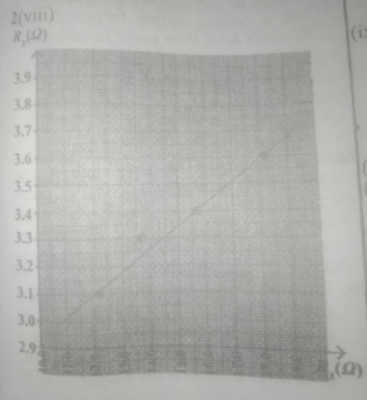
(viii) Plot a graph of R\(_2\) on the vertical axis and R\(_1\) on the horizontal axis
(ix) Determine the slope, s, of the graph
(x) Evaluate K = \(\sqrt{s}\)
(xi) State two precautions taken to ensure accurate results.
b(i) State two advantages of potentiometer over voltmeter for measuring potential difference
(ii) Define internal resistance of a cell.
Explanation
Video Explanation
No video available
Post your Contribution
Discussions (0)
No comments yet
Be the first to comment

