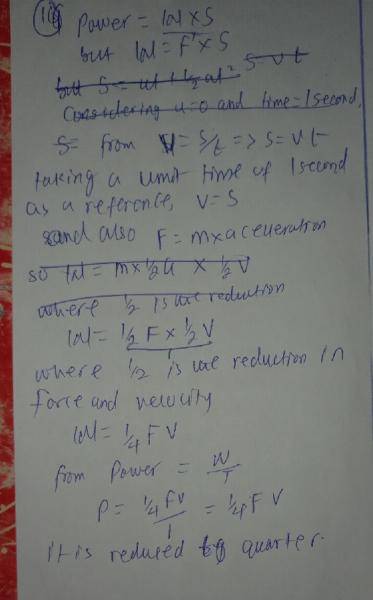
If the force and the velocity on a system are each reduced simultaneously by half, the power of the system is
doubled
reduced to a quarter
reduced by half
constant
Explanation
Video Explanation
Post your Contribution
Discussions (51)

From the scratch,
Power = workdone/time
p=w/t
since w=f x s
then p=f x s/t
since velocity = s/t
then p=f x v
So let assume the force and velocity of the system are 40N and 10m/s respectively.
Then p=fv, 40 x 10= 400w
After reducing the force and velocity by halfz, we have 20N and 5m/s respectively.
So p=fv; 20 x 5= 100w
P2/P1 =100/400=1/4
We can deduce from this that power is reduced to a quarter (i.e 1/4)

P=fv
F=1/2 ; v=1/2
P = 1/2 ×1/2
P = 1/4
P is reduced to a quarter
The answer is b

P=fd/t....V=d/t, ----»»» d=Vt, therefore power(P)=fvt/t...P=fv, when both force and velocity are been reduced by ½ simultaneously, we get P=f/2 x v/2. = P4=fv...power is increased by 4 and not reduced to a quarter
the power is equal to force multiply by the velocity ie
p = fv then if v and f is reduced by half simultaneously it implies that f = 1/2 and v = 1/2 ie fv=1/4.
since power = fv then power is equal 1/4.