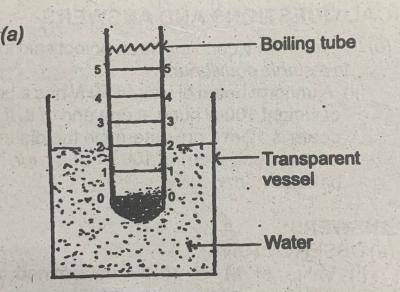
You are provided with a loaded boiling tube with a centimeter scale fixed inside it, a transparent vessel filled with water, standard masses 2 g, 5g and 10 g, and a slide vernier caliper. Use the diagram above as a guide to perform the experiment.
(i) Use the slide vernier caliper to measure and record the external diameter, D, of the boiling tube.
(ii) Evaluated A = 0.25\(\pi\)D\(^{2}\), where \(\pi\) = 3.14.
(iii) Place the loaded boiling tube gently in the water in the transparent vessel such that it floats vertically.
(iv) Read and record the depth of immersion, y, from the zero mark of the scale fixed inside, the boiling tube.
(v) Add a mass, m = 2g, to the boiling tube. Read and record the new depth of immersion, y, from the zero mark of the scale.
(vi) Evaluate h = (y - y\(_{0}\)), log h and log m.
(vii) Repeat the experiment for four other values of m = 5g, 7g, 10 g, and 12g. In each case, record y and evaluate h, log h, and log m.
(viii) Tabulate the results.
(ix) Plot a graph with log m on the vertical axis and log h on the horizontal axis starting both axes from the origin (0,0).
(b)(i) State in full the law on which the experiment in (a) is based.
(ii) A uniform cylindrical rod is 0.63 m long and it has a cross-sectional area of 0.1 m\(^{2}\). Calculate the depth of immersion of the rod if it floats vertically in a liquid of relative density 1.26. [density of rod =720 kg m\(^{-3}\), g = 10 m s\(^{-2}\)].
Explanation
Video Explanation
No video available
Post your Contribution
Discussions (0)
No comments yet
Be the first to comment

