(a)(i) State Coulomb's law of electrostatics.
(ii) The electron and proton of a hydrogen atom are separated by a mean distance of 5.2 x 10\(^{-11}\)m.
Calculate the magnitude of the electrostatic force between the particles.
[e = 1.6 x 10\(^{-19}\) C, (4\(\pi\) \(\mathcal{E}_{0}\))\(^{-1}\) = 9.0 x 10\(^{9}\) mF\(^{1}\)]
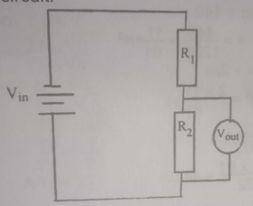
(b) The diagram above shows a potential divider circuit. (see diagram above)
i. Show that V\(_{out}\) = V\(_{in}\) (\(\frac{R_{1}}{R_{1} + R_{2}})\)
ii. If \(\frac{V_{in}}{V_{out}}\) = 2.5 and R\(_{2}\) = 30\(\Omega\), calculate R\(_{1}\)
iii. Define the volt.
(c) Explain why wood is not suitable for use as the core of transformers.
(d) State one application for the cathode ray tube.
Explanation
Video Explanation
No video available
Post your Contribution
Share:


