The effective potential energy, E, of a lunar satellite of mass, m, moving in an. elliptical orbit around the moon of mass, m, is given by
E = \(\frac{K^{2}}{2m_{1}r^{2}} - \frac{Gm_{1}m_{2}}{r}\) where r is the distance of the satellite from the mooń and G is the universal gravitational constant of dimensions, M\(^{-1}\)L\(^{3}\)T\(^{2}\).
Ďetermine the dimensions of the angular momentum, K, of the satellite using dimensional analysis.
Explanation
Video Explanation
No video available
Post your Contribution
Discussions (8)

To determine the dimensions of the angular momentum K using dimensional analysis, we can express the formula for the effective potential energy in terms of the fundamental dimensions of mass (M), length (L), and time (T).
The effective potential energy formula is given by:
E = K(2m₁/r²) - Gm₁m₂/r
where K is the angular momentum of the satellite.
Breaking down the terms in the formula in terms of their fundamental dimensions, we have:
[K] = [E] [r] / [(2m₁/r²) - (Gm₁m₂/r)]
Since [E] = [M L² T⁻²], [r] = [L], and [(2m₁/r²) - (Gm₁m₂/r)] = [M L T⁻²], we can substitute these values into the equation to get:
[K] = [M L² T⁻²] [L] / [M L T⁻²]
Simplifying this expression, we get:
[K] = [M L² T⁻¹]
Therefore, the dimensions of the angular momentum K are [M L² T⁻¹].

The solution to the question is VERY UNCLEAR.
Please explain and BREAK IT DOWN.
how did the minus sign in the question change to equality sign.
i'm sooooooooo confused please check
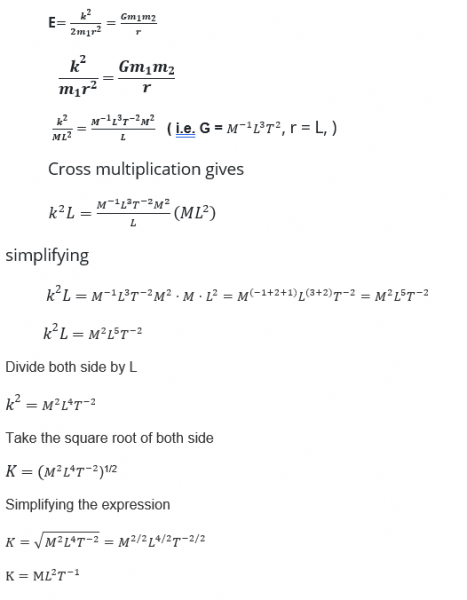
@MySchool please take note of the last comment by Olawuyi Israel.
The dimension you gave for the universal gravitational constant is wrong.
His is correct.
Please kindly help change it to avoid confusion

