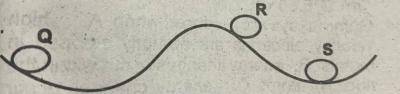
Suppose three identical steel balls Q, R, and S, are placed on an undulating ground as illustrated in the diagram above. Which of the balls is/are in neutral equilibrium?
S only
Q only
R only
Q and S only
Explanation
Video Explanation
No video available
Post your Contribution
Discussions (9)

In order for a steel ball to be in neutral equilibrium on an undulating ground, it would need to be positioned at the lowest point of the undulation where the gravitational potential energy is minimized. Therefore, the ball would be in neutral equilibrium at the bottom of a valley or trough formed by the undulating ground.
Greetings, The Myschool Team.
The correct answer is B(Q only) and not C (R only).
R is clearly in a state of unstable equilibrium, as any slight displacement will displace it further way from its present position.
S is in a state of stable equilibrium, as its position is such that any slight displacement will bring about torque that restores it back to its original position.
Q is in a state of neutral equilibrium, as if slightly displaced, Q would simply move to where it was displaced.
Thus, the correct answer is B(Q only) and not C (R only). Thank you.
The question asks about the neutral equilibrium of three steel balls (Q, R, and S) on an undulating ground. The correct answer is D, indicating that balls Q and S are in neutral equilibrium. This means that if these balls are slightly displaced, they will neither return to their original position nor accelerate away from it, but rather remain in their new position. Ball R, located at the bottom of a curve, is in stable equilibrium, meaning it will return to its original position if displaced. The other options are incorrect because they do not accurately identify the balls in neutral equilibrium.


