(a) You are provided with a battery, an ammeter, a voltmeter, a resistance box, a key and connection wires.
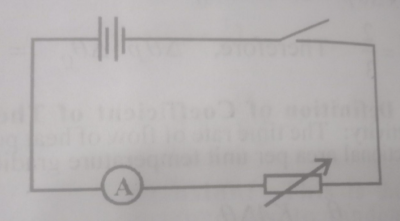
(i) Set up circuit as shown in the diagram above.
(ii) With the key opened, measure and record the e.m.f. E\(_o\) of the battery
(iii) With the key closed, select the resistance R=1 on the resistance box. Read and record the current, 1Ω.
(iv) Evaluate I\(^{-1}\).
(v) Repeat the procedure for five other values of R=2Ω,3Ω, 4Ω, 5Ω, and 6Ω.
In each case, record I and evaluate I\(^{-1}\) results.
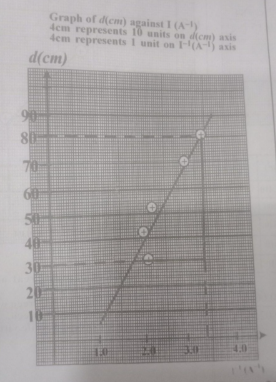
(vii) Plot a graph with R on the vertical axis and I\(^{-1}\) on the horizontal axis.
(Viii) Determine the slope, s, of the graph.
(ix) Determine the intercept C, On the vertical axis.
(x) State two precautions taken to ensure accurate results.
(b)(i) Define potential difference in an electric field.
(ii) A piece of resistance wire of diameter 0.2 mm and length 25 cm has a resistance of 7Ω. Calculate the resistivity of the wire of the battery. [ π = 22\7]
Explanation
Video Explanation
No video available
Post your Contribution
Discussions (2)

b)i)Electric potential difference, also known as voltage, is the external work needed to bring a charge from one location to another location in an electric field.
b)ii) diameter=0.2mm=0.02cm
resistance =7,length = 25cm, resistivity=?
P=RA/l
P=(7*22/7*(0.02)²/4)/25
P=(11*0.01*0.02)/25
P=0.000088ohms-meter

