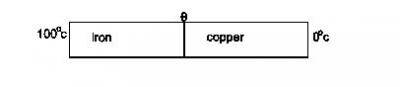
c(ii)
(a)(i) Define dew point. (ii) Explain why dew forms more quickly on the metal parts than on the rubber parts of a bicycle placed in the open overnight.
(b)(i) Explain the statement. the specific heat capacity of copper is 400 J/kg/K. (ii) Two metals, P and Q are supplied with the same quantity of heat.
If the ratio of the specific heat capacity of P to Q is 3: 1 and their masses are in the ratio I:2 respectively.
calculate the ratio of the temperature rise of P to Q.
(c)(i) Define coefficient of thermal conductivity of a material.
The diagram above c(ii) illustrates a composite bar of iron and copper. The bar is insulated along its sides and it has a diameter of 10 mm. The length and thermal conductivity of the iron are 0.15 m and 40 W/m/K, respectively and those of copper are 0.05 m and 360 W/m/K, respectively. If the free ends of the iron and copper are kept at 100°C and 0°C respectively. calculate the (i) temperature at the interface between the bars; (ii) rate of heat flow along the bar.
Explanation
Video Explanation
No video available
Post your Contribution
Discussions (3)

It's blank ⬜⬜⬜⬜
It's not showing the rest of the question neither is it showing the solutions.
I don't think the area of the bar should be solved with πr². I think the area should be the Total Surface Area of the bar instead.

