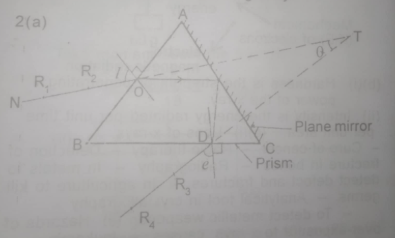
Using the above diagram as a guide, carry out the following experiment:
- Place the equilateral triangular glass prism on the drawing paper. Trace the outline ABC of the prism.
- remove the prism. Draw a line NO such that it makes an angle i = 25º with the normal at point O on side AB
- fix two pins R\(_{1}\) and R\(_{2}\) vertically on line N0. Replace the prism on its outline;
- place the reflecting surface of the plane mirror in contact with the face AC of the prism;
- looking through the face BC of the prism, fix two other pins at R\(_{3}\) and R\(_{4}\) such that the pins appear to be in a straight line with the images of the pins at R\(_{1}\) and R\(_{2}\);
- remove the prism, the mirror, and the pins. Draw a line to join points R\(_{4}\) and R\(_{3}\)
- produce line R\(_{4}\)R\(_{3}\) to meet line NO produced at T;
- measure and record the angle \(\theta\) at T and e at D;
- repeat the procedure for four other values of i = 30°, 35°, 40°, and 45°. In each case, measure and record the corresponding values of \(\theta\) and e. Tabulate your readings;
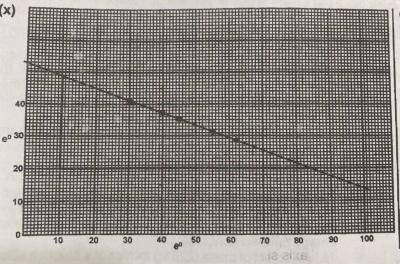
- plot a graph of e on the vertical axis and \(\theta\) on the horizontal axis;
- evaluate k = s\(^{-1}\)
- state two precautions taken to ensure accurate results. [Attach your traces to your answer booklet]
(b)i. State four characteristics of the image of an object formed by a plane mirror.
ii. State two Conditions necessary for total internal reflection to occur in a medium.
Explanation
Video Explanation
No video available
Post your Contribution
Share:


