You are provided with two resistance wires labeled A and B, a1\(\Omega\) standard resistor Rx, and other necessary apparatus.
- Connect R\(_{x}\) in the left-hand gap of the metre bridge, a length L= 100cm of wire A in the right-hand gap, and the other apparatus as shown in the diagram above.
- Determine and record the balance point P on the bridge wire NQ.
- Measure and record l\(_{x}\) = NP and l\(_{y}\) = PQ.
- Evaluate R\(_{1}\) = \(\frac{I_{y}}{L_{x}}\) = R\(_{x}\)
- Repeat the procedure for four other values of L= 95, 85, 75 and 65cm. In each case, determine and record the balance point P and the length l\(_{x}\) and l\(_{y}\). Also, evaluate R\(_{1}\).
- Repeat the experiment with the second wire B. Obtain the balance points P and the values of and l\(_{x}\) and l\(_{y}\).
- Evaluate R\(_{1}\) = \(\frac{I_{y}}{L_{x}}\) = R\(_{x}\) in each case. Tabulate your readings.
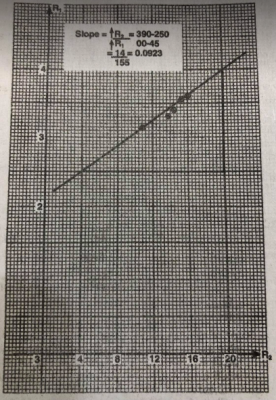
- Plot a graph of R\(_{2}\) on the vertical axis against R\(_{1}\) on the horizontal axis.
- Determine the slope, s, of the graph.
- Evaluate k = \(\sqrt s \).
- State two precautions taken to obtain accurate results.
(b)i. State two advantages of using a potentiometer over a voltmeter for measuring the potential difference.
ii. Define the internal resistance of a cell.

Explanation
Video Explanation
No video available
Post your Contribution
Share:
Discussions (1)

07066245221ade
1 year ago
The question failed to open the diagram
Please fix this error because I also tried opening it on the myschool app it was still them smart problem

