You are provided with a glass block, a plane mirror, and optical pins.
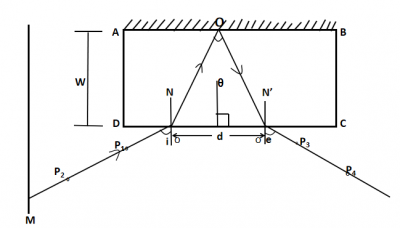
- Place the glass block on a drawing sheet and trace its outline ABCD as shown in the diagram above.
- Remove the block, measure, and record the width W of the block.
- Draw a normal ON to DC at a point about one-quarter the length of DC.
- Draw a line making an angle i = 10° with the normal.
- Replace the block on its outline and mount the plane mirror vertically behind the block such that it makes good contact with the face AB.
- Stick two pins P\(_{1}\) and P\(_{2}\) on the line MO.
- Looking through the face CD, stick two other pins P\(_{3}\) and P\(_{4}\) such that they appear to be in a straight line with the images of pins P\(_{1}\) and P\(_{2}\) seen through the block.
- Join P\(_{3}\) and P\(_{4}\) with a straight line and extend it to touch the face CD at O.
- Draw a perpendicular line from the midpoint of OO to meet AB at QD.
- Draw lines OQ, O'Q, and normal O'N' produced.
- Measure and record \(\theta\), e and d.
- Evaluate m = sin e and n = cos(\(\frac{\theta}{2}\))
- Repeat the procedure for i = 20°, 30°, 40° and 50°.
- Tabulate your readings.
- Plot a graph with m on the vertical axis and n on the horizontal axis.
- Determine the slope, s, of the graph and evaluate q = 2Ws.
- State two precautions taken to ensure accurate results. (Attach your traces to your answer booklet.)
(b)i. Explain the term refractive index and give a mathematical expression for it in terms of wavelength.
ii. State the conditions necessary for total internal reflection to occur for a given pair of media.
Explanation
Video Explanation
No video available
Post your Contribution
Share:
Discussions (3)

Tim234D
1 year ago
Greetings, The Myschool Team.
The diagrams for this question and the questions under this year are not provided. It would be appreciated if they were provided. Thank you.

