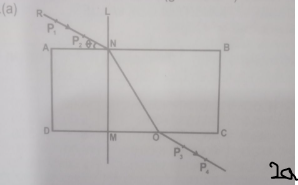
Use the diagram above as a guide to carry out the following experiment.
(b)i. State Snell's law of refraction.
ii. Calculate the critical angle for the glass prism used in the experiment above if its refractive index is 1.5.


Observation/table of values
| S/N | \(\theta\)(0) | Mo(cm) | No(cm) | \(\theta\)=\(\frac{MO}{NO}\) | Cos \(\theta\) |
| 1 | 75.0 | 1.60 | 6.60 | 0.100 | 0.260 |
| 2 | 65.0 | 3.00 | 7.00 | 0.290 | 0.420 |
| 3 | 55.0 | 3.10 | 7.30 | 0.390 | 0.570 |
| 4 | 45.0 | 3.10 | 7.60 | 0.480 | 0.700 |
| 5 | 35.0 | 4.50 | 8.00 | 0.520 | 0.820 |
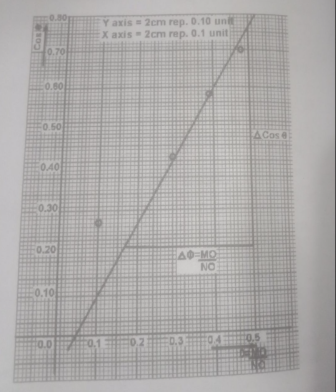
Slope (s) = \(\frac{\bigtriangleup \text {cos} \theta}{\bigtriangleup \theta} = \frac{y_{2}-y_{1}}{x_{2}-x_{1}}\)
\(\frac{MO}{NO} = \frac{0.77-0.20}{0.50-0.17}\)
\(\frac{0.57}{0.33}\)
Slope (s) = 1.72
Graph cos \(\theta\) against = \(\phi\) = \(\frac{MO}{NO}\)
see the graph above.
PRECAUTIONS; i
- Ensured pins are vertical/ erect.
- Ensured neat traces/sharp pencil (shown on trace)
- Ensured reasonable spacing of pins (about 4cm apart)
- Avoided parallax error in reading protractor/metre rule.
(b)i. Snell's law states that the ratio of the sine of the angle of incidence to the sine of the angle of refraction is a constant for a given pair of media.
Or \(\frac {\text {Sin i}}{\text {Sin r}}\) = a constant for a given pair of media
Where i = angle of incidence;
r = angle of refraction
ii. n = \(\frac{i}{\text{Sin c}}\)
Sin c = \(\frac{1}{1.5}\) = 0.6667
C = sin\(^{-1}\) 0.6667
C = 41.80°





Contributions ({{ comment_count }})
Please wait...
Modal title
Report
Block User
{{ feedback_modal_data.title }}