lens formula
refraction laws
reflection laws
mirror formula
Explanation
Video Explanation
No video available
Post your Contribution
Discussions (16)

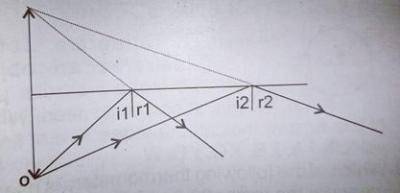
This setup is for verifying the laws of refraction ✅
Why?
The diagram shows incident rays (i₁, i₂) and refracted rays (r₁, r₂) at a boundary.
Angles of incidence and refraction are labeled and compared.
The rays bend at the surface, which is a clear sign of refraction, not reflection.
Such a setup is typically used to verify Snell’s laws:
The incident ray, refracted ray, and the normal all lie in the same plane.
sin𝑖/sin𝑟=constant
Why not the others?
Lens formula → needs a lens and image/object distances.
Reflection laws → rays would bounce off the same surface (no bending into another medium).
Mirror formula → needs a mirror with focal length, image formation.
✅ Correct answer: B — refraction laws


There is no answer to this question. It would be greatly appreciated if you corrected this. Thank you.

answer is B refraction laws diagram shows through glass prism. the bending of the ray of light as it enters and exits the pism due to refraction which is governed by the laws of refraction
The diagram represents an experimental setup involving the incidence and refraction of light at the boundary between two media. This can be identified by the angles
𝑖
1
i
1
,
𝑟
1
r
1
,
𝑖
2
i
2
, and
𝑟
2
r
2
which correspond to the angles of incidence and refraction at two different points.
This setup is used to verify:
B. refraction laws
The diagram shows how a light ray changes direction as it passes from one medium to another, adhering to Snell's Law, which is the fundamental law of refraction. This law states that the ratio of the sines of the angles of incidence and refraction is constant and equal to the ratio of the refractive indices of the two media.

