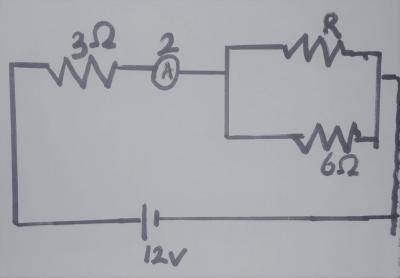
3\(\Omega\)
6\(\Omega\)
4\(\Omega\)
5\(\Omega\)
Explanation
Video Explanation
Post your Contribution
Discussions (6)

in the diagram above resistance R and 6ohms are in parallel so let's add them both
1/R=1/R+1/6
=6+R/6R
R=6R/6+R
(6R/6+3)ohms are now connected in series with the 3ohms
therefore
R=6R/6+R+3/1
=6R+3(6+R)/6+R
=6R+18+3R=
now V=IR
R=V/I
where V=12,I=2
R=6R+18+3R/6+R
6R+18+3R/6+R=12/2
2(6R+18+3R)=12(6+R)
12R+36+6R=72+12R
18R+36=72+12R
18R-12R=72-36
6R=36
R=36/6
=6ohms

I hope this is understandable
Here is an explanation i think should be more easier.
voltage across 3 ohm resistor is V = 3 × 2 = 6 V.
voltage across the parallel combination is
V = 12 - 6 = 6 V
Current through the 6 ohm resistor = 6/6 (from I = V/R)
current across R, = 2 - 1 = 1 A.
voltage across R is
V = 6/1 = 6 V
from the diagram, v= 12, i= 2, R= ?
using the formula v=iR
12= 2 × R
R= 12/2
R= 6

