If a sound wave goes from a cold air region to a hot air region, its wavelength will
increase
decrease
decrease then increase
remain constant
Explanation
Video Explanation
No video available
Post your Contribution
Discussions (51)

Myschool pls I will be happy if this contribution will be taken
Temperature is also a condition
that affects the speed of sound.
Heat, like sound, is a form of
kinetic energy. Molecules at
higher temperatures have more
energy, thus they can vibrate
faster. Since the molecules
vibrate faster, sound waves can
travel more quickly.
We can see dat speed varies with temperature ie the higher the temperature the higher the speed and vise versa
Similarly speed is directly proportional to wavelength. Equating the both we can see that wavelength is directly proportional to temperature.
Hence in the hot region the wavelength is higher.
Thanks

Using for instance at night when you shout your voice will be faster and will be hear from a far distance, this is due to the calmness of the night. But at noon you hardly hear a sound from a far distance. That could explain that sound decrease in a hot region(noon) but increase in cold region. I agree with option B


FROM MY PERSPECTIVE, When a sound wave moves from a cold region to a hot region, its wavelength increases. This happens because the speed of sound is higher in hot air compared to cold air. Since the frequency of the sound wave remains constant, the increase in speed results in a longer wavelength, HOW ABOUT THIS?...I DO AGREE WITH YOUR POINT TOO
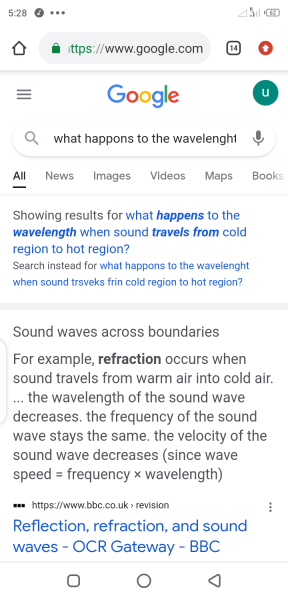
if it decreases when coming from hot region to cold the shouldn't it increase when doing the opposite
surely it can't be the same for the both of them
from hot to cold--decrease
from cold to hot--increase

Sound travels FARTHER in cold air (e.g at night) but travels FASTER in warm air (e.g at noon). Now, we are talking about speed. From Velocity =frequency x Wavelength, if velocity increases, wavelength should increase since frequency is constant. That's how I see it!

U said sqare root nt d square so it cant increase d velocity and also we are talking abt wave lenght nt d movement of sound
This means that when sound travels from hot air to cold air or from cold air to hot air it will refract. You can notice this on a hot day or a cold night. On a hot day the air near the ground is hot so the sound wave bends upwards from the hot air into the cold air



