(a) Explain the terms:- uniform acceleration and average speed.
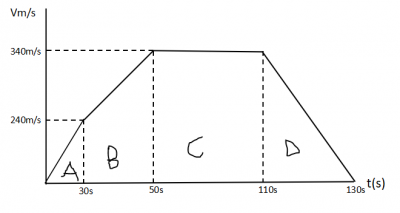
(b) A body at rest is given an initial uniform acceleration of 8.0ms\(^{-2}\) for 30s after which the acceleration is reduced to 5.0ms\(^{-2}\) for the next 20s. The body maintains the speed attained for 60s after which it is brought to rest in 20s. Draw the velocity-time graph of the motion using the information given above.
(c) Using the graph, calculate the: (i) maximum speed attained during the motion; (ii) average retardation as the body is being brought to rest; (iii) total distance travelled during the first 50s; (iv) average speed during the same interval as in (ii).


(a) Uniform acceleration occurs when the change in velocity per unit time is constant. The S.I. unit is ms\(^{-2}\).
\(a = \frac{v - u}{t}\); a - uniform acceleration, v - final velocity, u - initial velocity, t - time.
Graphically,
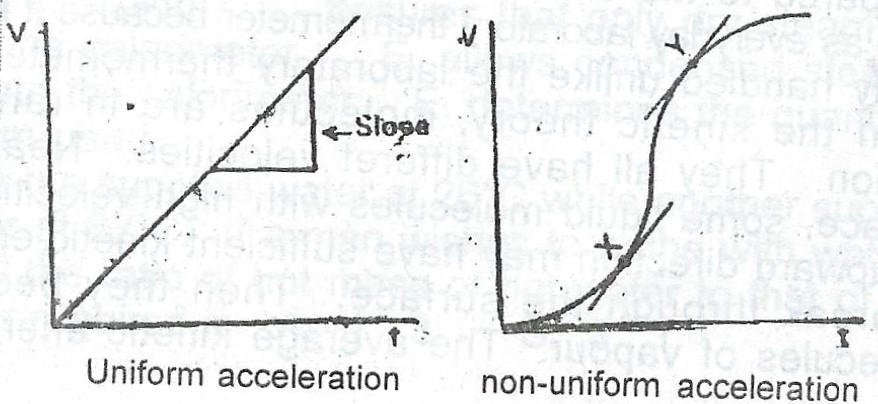
acceleration is the same acceleration at x is different every point from that at Y.
Note - acceleration is given by slope in both graphs.
(b) SEE DIAGRAM ABOVE.
V\(_1\) = u + at = 0 + 8 x 30 = 240m/s
V\(_2\) = V\(_1\) + at = 240 + 50 x 20 = 340m/s
(i) Maximum speed = 340 m/s.
(ii) \(a = \frac{v - u}{t} = \frac{0 - 340}{20} = -17 ms^{-2}\)
(iii) Area of A = \(\frac{1}{2} \times 30 \times 240 = 3600m\)
Area of B = \(\frac{1}{2}\) x ( 240 + 340) x 20 = 5600m
Total distance in the first 50s: 3600 + 5800 = 9400m
(iv) Average speed during the first 50s = \(\frac{9400m}{50s} = 188 ms^{-1}\)





Contributions ({{ comment_count }})
Please wait...
Modal title
Report
Block User
{{ feedback_modal_data.title }}