Post UTME Past Questions Agent
WAEC and NECO CBT Software for Computers and Laptops - Candidates, Schools, Centres, Resellers - 100% Offline -Download Now

2002 JAMB Physics Theory (a) Define the following terms as applied to a convex mirror: (i) principal focus; (ii)...

Physics
JAMB 2002

(a) Define the following terms as applied to a convex mirror:

(i) principal focus; (ii) pole (iii) radius of curvature.

(b) State one advantage and one disadvantage of using a convex mirror as a driving mirror.

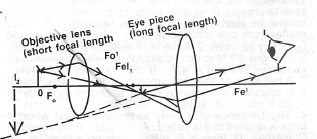
(c) Draw a clearly labelled diagram to illustrate how two converging lenses may be arranged to form a compound microscope.

(d) An object 2.5 mm long is viewed through a converging lens of focal length 10.0 cm held close to the eye. A magnified image of the object is formed 30.0 cm from the lens. Calculate the:

(i) distance of the object from the lens; (ii) size of the image; (iii) power of the lens.

Post-UTME Past Questions - Original materials are available here - Download PDF for your school of choice + 1 year SMS alerts
Post UTME Past Questions Agent
WAEC and NECO CBT Software for Computers and Laptops - Candidates, Schools, Centres, Resellers - 100% Offline -Download Now
Explanation

(a)(i) Principal focus of a convex mirror is a pc.nt on the principal axis on which all rays parallel and close to the principal axis appear to diverge after reflection.

(ii) The pole is the centre of the mirror through which the principal axis pass.

(iii) Radius of curvature is the radius of the sphere from which the mirror was cut.

(b) Advantages of using convex mirror for driving

-wide field of view

-image is always upright.


Disadvantages of using convex for driving:

-image is smaller

-image appears further away and gives false impression of the distance.
 

(d)(i) \(\frac{1}{u} + \frac{1}{v} = \frac{1}{f}; \frac{1}{u} - \frac{1}{30} = \frac{1}{10}; \frac{1}{u} = \frac{1}{10} + \frac{1}{30}\)

= \(\frac{4}{30} = \frac{2}{15}; u = \frac{15}{2}\) = 7.5cm

(ii) \(\frac{\text{image size}}{\text{object size}} = \frac{\text{image distance x object size}}{\text{object distance}}\)

= \(\frac{30 \times 0.25}{7.5} = 1cm\)

(iii) Power = \(\frac{1}{\text{focal length (in metre)}} = \frac{1}{0.1}\)

= +10.0 dioptre 0.1


Report an Error Ask A Question Download App
Post-UTME Past Questions - Original materials are available here - Download PDF for your school of choice + 1 year SMS alerts
Your School's Whatsapp Group - Join Us now
WAEC and NECO CBT App for Mobile Devices - Candidates, Schools, Centres, Resellers - 100% Offline -Download Now

Contributions ({{ comment_count }})

Please wait...

{{ settings.no_comment_msg ? settings.no_comment_msg : 'There are no comments' }}

Quick Questions

Post your Contribution

Please don't post or ask to join a "Group" or "Whatsapp Group" as a comment. It will be deleted. To join or start a group, please click here

{{ quote.posted_by.display_name }}
{{ settings.form_textarea_description }}
 
WAEC and NECO CBT App for Mobile Devices - Candidates, Schools, Centres, Resellers - 100% Offline -Download Now
Your School's Whatsapp Group - Join Us now
Post UTME Past Questions Agent
WAEC and NECO CBT Software for Computers and Laptops - Candidates, Schools, Centres, Resellers - 100% Offline -Download Now
Post-UTME Past Questions - Original materials are available here - Download PDF for your school of choice + 1 year SMS alerts
Your School's Whatsapp Group - Join Us now
WAEC and NECO CBT App for Mobile Devices - Candidates, Schools, Centres, Resellers - 100% Offline -Download Now
Post-UTME Past Questions - Original materials are available here - Download PDF for your school of choice + 1 year SMS alerts
WAEC and NECO CBT Software for Computers and Laptops - Candidates, Schools, Centres, Resellers - 100% Offline -Download Now
